


.png)
Single Girder or Double Girder? How to Pick the Right EOT Crane for Your Application
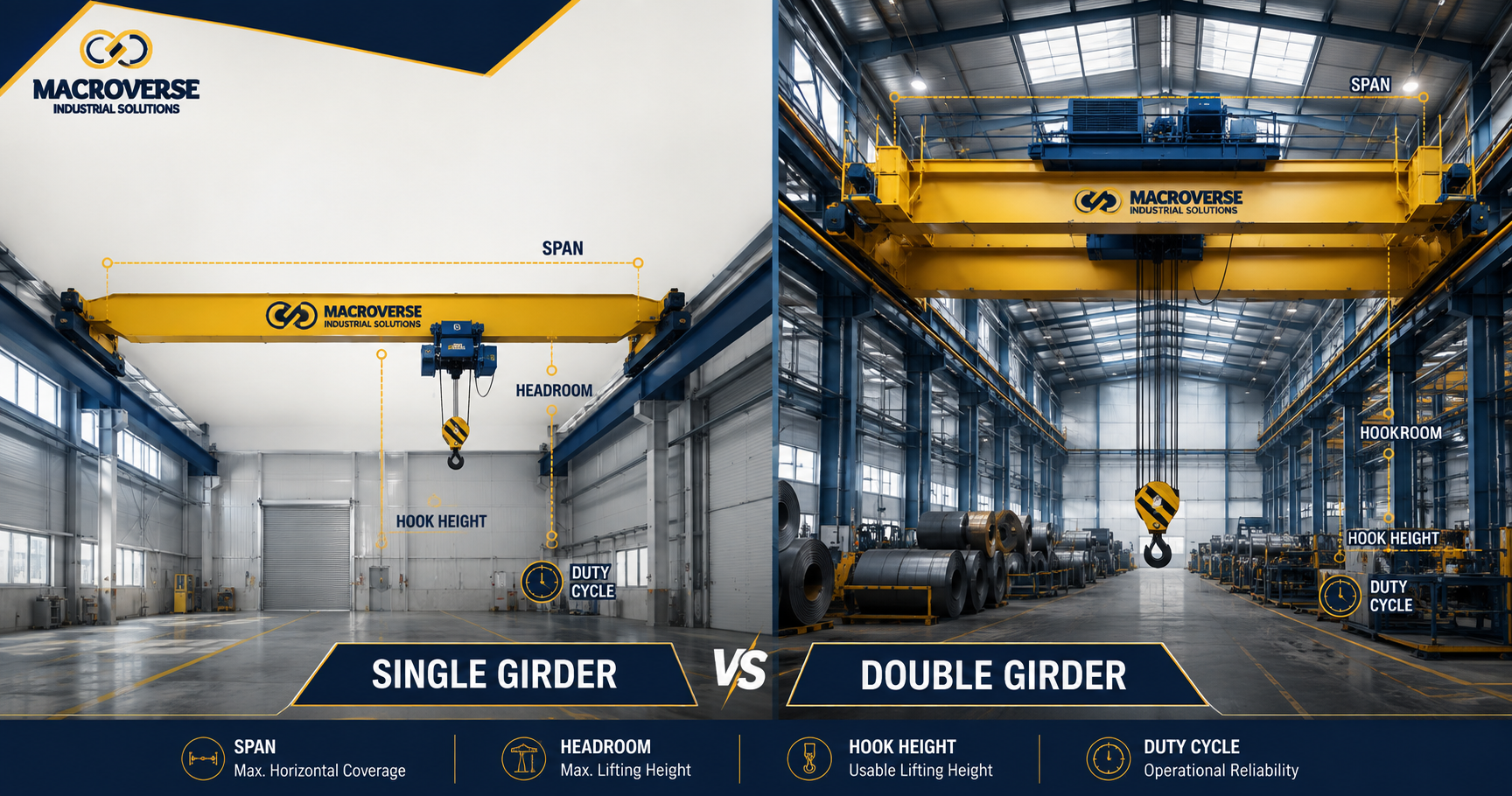
Single vs. Double Girder: How the Bridge Design Changes the Crane
The key difference starts with the bridge, the structure that spans the runway rails and carries the hoist.
Single girder cranes use one main beam, typically a rolled I-section for moderate spans, with fabricated plate or box girders used as span or capacity requirements increase. The hoist and trolley run along the bottom flange, so the girder depth and hoist arrangement directly affect available headroom.
Double girder cranes use two parallel girders, typically fabricated box sections, connected by end trucks and cross members. The hoist trolley runs on rails positioned on top of the girders, allowing a different hoist configuration and potentially greater hook height within the same building envelope. The two-girder arrangement also distributes the load across the bridge structure.
These structural differences influence headroom, span capability, hook height, crane stability and overall configuration. That is why the choice between single and double girder should come from the application and engineering requirements—not from a tonnage chart alone.
At Macroverse, girder selection starts with the numbers: span, capacity, lift height, duty cycle, headroom and the building structure all have a role in determining the right configuration.
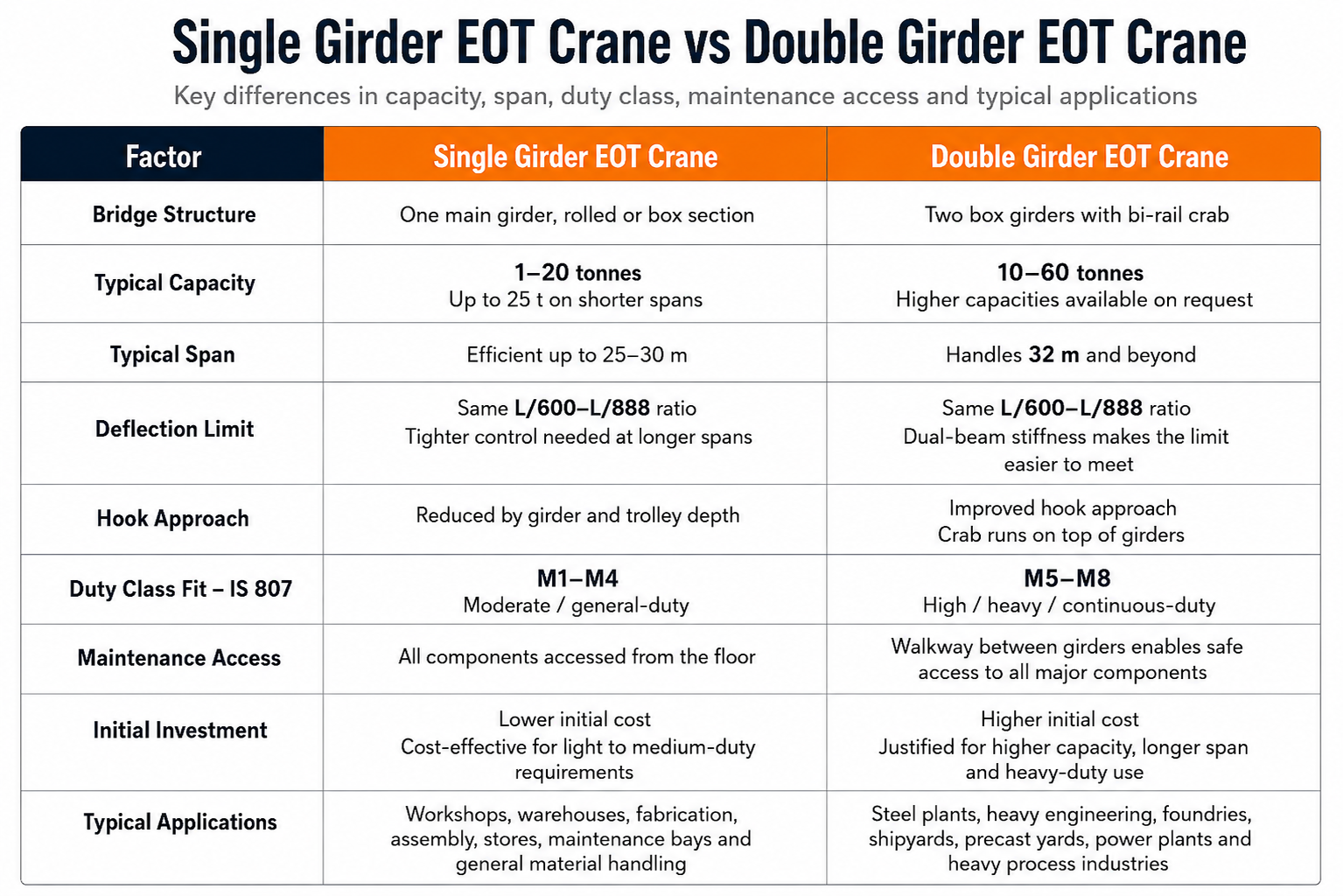
The table below gives a quick comparison of the two configurations across the factors that typically influence crane selection.
Load Capacity
Single girder cranes are commonly specified from 1 to 20 tonnes, with fabricated box girders pushing toward 25 tonnes on shorter spans.
Double girder cranes typically start around 10 tonnes and scale up to 60, 100, or more for heavy industrial and mill duty work.
That overlap zone, roughly 10 to 20 tonnes, is where tonnage stops being the deciding factor and span, duty class, and hook approach take over.
It's also where specs get written as double girder by default, even when a single girder crane would do the job for less, or the reverse happens, someone picks single girder purely to save money when the actual duty cycle really calls for double girder. This is where we spend most of our time on application review before quoting, because a tonnage figure alone just isn't enough to lock in a configuration in this range.
Span
Span affects girder stiffness and deflection directly. As span increases, the girder needs to resist greater bending and maintain acceptable deflection under the combined weight of the hoist, trolley and rated load.
This is one reason single girder cranes become less practical as span and capacity increase. However, there is no fixed span at which a single girder must give way to a double girder. The appropriate configuration depends on the girder section, loading, duty class and allowable deflection.
Girder Deflection
IS 807 sets stiffness requirements for crane girders, with dead-load deflection accounted for through girder camber. Lateral deflection also needs to be controlled to limit sway during acceleration and braking and maintain smooth travel along the runway.
A girder can meet its strength requirement and still be limited by deflection before reaching its rated load. Single girder cranes are commonly used for spans around 25–30 metres, while double girder configurations can extend beyond this depending on capacity, section design and duty class.
The important point is that span alone does not determine the girder configuration. The structural design has to satisfy both strength and stiffness requirements under the actual loading conditions.
Hook Approach and Headroom
Hook approach and available headroom can influence the crane configuration, particularly where building clearances are limited.
In a single girder crane, the hoist typically runs beneath the girder, which affects the available hook height and approach. Where the load needs to be lifted close to the roof structure or an existing obstruction, these clearances need to be checked during specification.
In a double girder crane, the crab runs on top of the girders, allowing a different hoist arrangement and potentially greater hook height within the same building envelope.
The relevant check is the required hook height, approach and clearances against the actual building geometry—not rated capacity alone.
Duty Class
Capacity tells you what the crane needs to lift. Span tells you how far it travels. Duty class describes how frequently and intensively it will operate.
IS 807 classifies cranes from M1 to M8 based on operating conditions over the crane's design life, including operating time and the frequency and magnitude of loads handled. A crane used occasionally with mostly light loads has different structural and mechanical requirements from one operating across multiple shifts with frequent near-capacity lifts.
Duty class also influences the design loads and fatigue considerations used to size the crane structure and mechanisms. Two cranes with the same rated capacity can therefore require different girder sections and components when their operating conditions differ.
For example:
- A 15–20 tonne crane operating occasionally under a lower duty class may be suitable for a single girder configuration, depending on span and other design parameters.
- The same rated capacity under multi-shift operation with frequent near-capacity lifting may require a higher duty classification and a different structural configuration.
Rated capacity alone is not enough to define the crane specification. The actual duty cycle needs to be established before the crane is sized.
Maintenance Access
Single girder cranes generally have a more compact mechanical arrangement, with maintenance access concentrated around the hoist, drive and electrical components.
Double girder cranes can accommodate a walkway between the girders, providing access to the crab, hoist and electrical components on configurations designed for it. For cranes operating continuously or across multiple shifts, this can make inspection and maintenance more accessible.
The relevant consideration is the level of access required for the crane's operating and maintenance conditions.
Cost and Runway Impact
Single girder cranes generally have a lower initial cost because they use less structural steel and impose lower dead loads on the runway and supporting structure. This can also reduce the structural requirements for the runway and building, particularly in a new facility.
Double girder cranes typically have a higher initial cost and may require greater runway and supporting-structure capacity. For applications involving higher capacities, longer spans or intensive duty cycles, the additional structural capacity may justify the higher initial investment.
Runway impact should be assessed through actual wheel-load calculations. Crane dead weight, rated load, wheel arrangement and dynamic effects all influence the loads transferred to the runway beams and supporting structure.
The useful comparison, therefore, is not simply single girder price vs. double girder price. It is the total system cost against the crane's actual operating requirements, including the runway, building structure, duty cycle and service conditions.
Can a Single Girder Crane Replace a Double Girder Crane?
Sometimes. The configuration should be determined by the application requirements rather than by a standard capacity range.
A single girder crane can be suitable where the required capacity, span, duty class, hook height, hook approach, deflection and wheel loads remain within its design limits. If those requirements can be met, it may offer a lower overall system cost.
A double girder configuration becomes more relevant as capacity, span, hook height, duty cycle or structural requirements increase. The decision should be based on the complete crane and building design, not the price difference between the two configurations.
A Practical Decision Framework
Work through these factors before selecting the girder configuration:
- Confirm the working load. Base the design on the actual load spectrum and routine lifting requirements.
- Establish the span. Check the runway layout along with the required deflection and structural limits.
- Define hook height and approach. Account for roof clearance, existing structures and the required lifting position.
- Establish the duty class. Assess operating hours, load frequency and the expected service conditions in accordance with IS 807.
- Check the supporting structure. For existing buildings, verify runway and structural capacity. For new buildings, coordinate crane loads with the structural design early.
- Compare the total system cost. Include the crane, runway, supporting structure, maintenance access and expected operating requirements.
Where Each Configuration Typically Fits
Single girder cranes are commonly used in fabrication shops, warehouses, tool rooms, light assembly areas and maintenance bays where capacity, span and duty requirements remain within the configuration's design range.
Double girder cranes are more commonly used for higher capacities, longer spans and demanding operating conditions, including heavy engineering, steel processing, foundries and other high-utilisation applications.
These are typical applications, not fixed boundaries. The actual specification should determine the configuration.
The Macroverse Approach to Selecting the Crane Configuration
At Macroverse, crane selection starts with the application rather than a standard configuration. Our engineering team evaluates the working load, span, runway arrangement, lifting height, hook approach, headroom, duty classification, operating conditions, wheel loads, building constraints and maintenance requirements before recommending an EOT crane configuration.
The result is a crane engineered around how your operation works—not simply a configuration selected from a capacity chart.
Planning a new EOT crane installation or replacing an existing crane? Talk to the Macroverse engineering team to evaluate your application and determine the right configuration.
Still comparing your options? Here are answers to a few common questions about single and double girder crane configurations.