


Custom vs Standard EOT Cranes: Cost, Compliance and How to Choose
Custom vs Standard EOT Cranes: Cost, Compliance and How to Choose
Standard EOT cranes are catalogue cranes built from a proven design in a fixed range of spans, capacities and duty classes. They ship faster because the design, components and spares are already in volume production.
Custom EOT cranes are engineered around a specific site or process. They are designed when your headroom, load shape, environment or duty class falls outside the catalogue range, for example a low-headroom bay, a hot or corrosive shop floor, or a three-shift operation with near-continuous lifting.
Choosing between the two matters because if you get it wrong, you pay twice: once at purchase, and again every year in brake replacements, downtime and runway repairs.
A standard crane under-classed for a 20-hour shift wears out early. A custom crane built for a problem a catalogue model already solves adds cost and weeks of lead time for nothing.
This guide covers the five checks that settle the decision (load, duty class, building, environment, runway), plus the cost drivers and IS compliance points that shape every quotation.
1. When Is a Standard EOT Crane Suitable?
A standard EOT crane fits when your lifting requirements fall inside an established design: a common capacity, a common span and a duty class that matches your operation.
A standard crane works when:
- Lifting capacity: The rated capacity covers the heaviest load plus the lifting beam, slings and magnets or grabs.
- Span and runway: The runway centre-to-centre distance matches a standard girder span, and the existing columns and beams can carry the wheel loads.
- Lifting height: The standard hook height reaches every working position under the roof truss.
- Duty class: The crane's class matches your lifts per hour and your typical load (see Section 4).
- Headroom: The distance from the runway rail to the lowest roof member is enough for the girder, hoist and hook block.
- Environment: Standard motors (typically IP55, class F insulation) and standard paint suit an indoor, dry, ambient-temperature shop.
A machine shop with one bay, a 10 t load and 8 to 12 lifts per hour is a typical example. For most workshop applications up to about 10 t, a standard single girder or double girder crane is enough, and customization only adds cost.
A standard crane is not a light-duty crane. A correctly specified standard double girder crane can run in a Class III (heavy) duty application without modification.
Single Girder vs Double Girder EOT Cranes: Key Differences
This is the first decision in most projects.
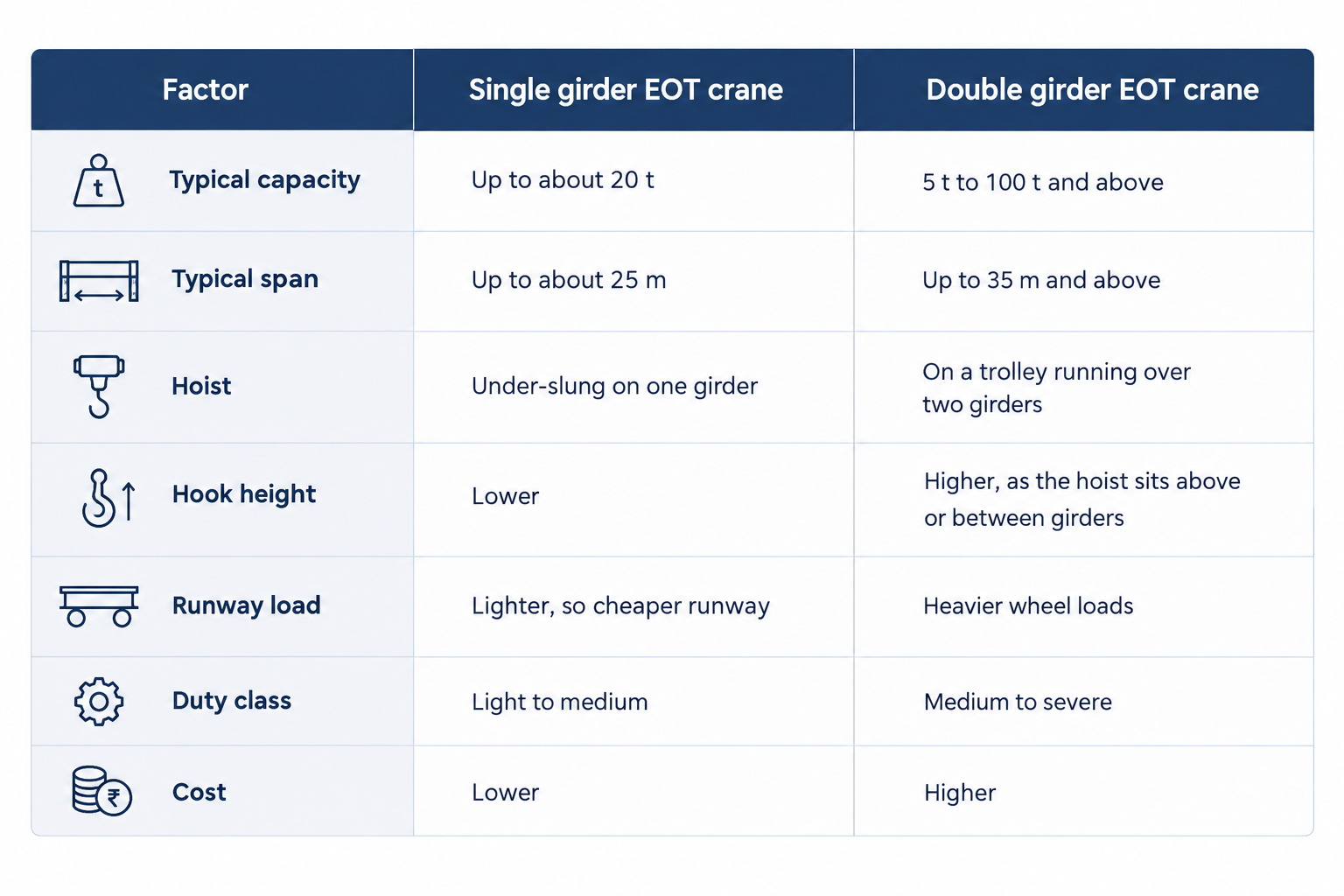
Choose a single girder crane for light to medium duty and moderate spans. Choose a double girder crane when you need higher capacity, heavier duty, long spans or maximum hook height.
When Should You Consider Custom EOT Cranes?
Custom EOT cranes make sense when a fixed requirement cannot be met by a catalogue design. Each modification should solve a named problem.
Non-standard spans or runway arrangements
Some plants have spans between standard sizes, an existing runway that cannot be changed, or bays of different widths. The girder is designed around the building instead of the other way round.
Limited headroom
When the roof truss sits close to the runway, a standard top-running double girder crane may not reach the hook height you need. A low-headroom design places the hoist between the girders, which recovers vertical space. The trade-off is a more complex girder and a higher price. Confirm the minimum hook approach and the clearance under the roof truss before you finalise the order.
Specialized loads
Coils, long bars, ladles, moulds and paired components need lifting beams, C-hooks, grabs, magnets or tongs. Tandem lifts with two hoists on one girder, or a dual hoist with main and auxiliary hooks, are common examples.
Demanding duty cycles
If your operation runs 20 hours a day or lifts near rated capacity on most cycles, you may need a higher duty class, oversized brakes and gearboxes, or redundant drives. A catalogue crane rated for a lower class will wear out early.
Challenging operating environments
Foundries and forge shops need heat shields, high-temperature insulation and special cable. Outdoor yards need rain covers and corrosion-resistant paint. Chemical and dusty areas need sealed enclosures and higher IP ratings. Hazardous areas need flameproof or explosion-protected equipment.
Site-specific constraints
Existing machinery, a production line, a restricted access route or a fixed installation window can change the girder design, the power feed or the erection method. Under-running cranes, which hang from the roof structure, are another option when floor space or columns are limited.
Before approving a customization, ask the supplier three questions: what problem does it solve, why can't a standard option solve it, and what does it add to price and delivery time.
3. Standard vs Custom EOT Cranes at a Glance
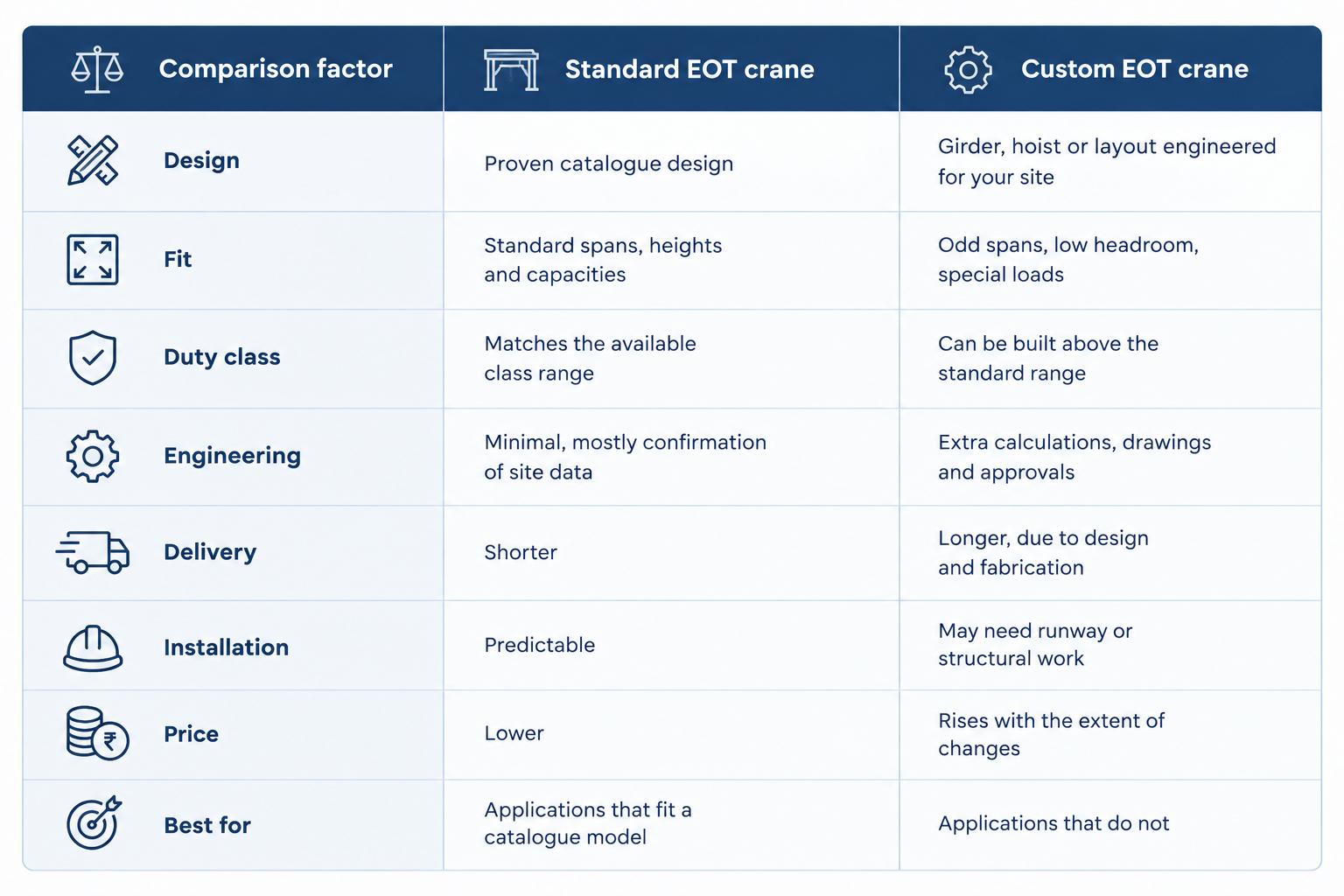
Custom EOT cranes cost more and take longer, so use them only where the site or the process demands it. When the application fits a standard model, a standard crane delivers faster, with proven design and easier spare parts.
4. Duty Class and Lifting Capacity: Why Tonnage Alone Isn't Enough
Two 10 t cranes can differ widely in motors, gearboxes, brakes, wheels and girder fatigue life. Duty class sets those differences.
Indian practice classifies cranes under IS 3177 and IS 807, which align with international schemes such as FEM 1.001 (A1 to A8) and ISO 4301 (M1 to M8). Buyers also see CMAA classes (A to F) on imported equipment. In simple terms:
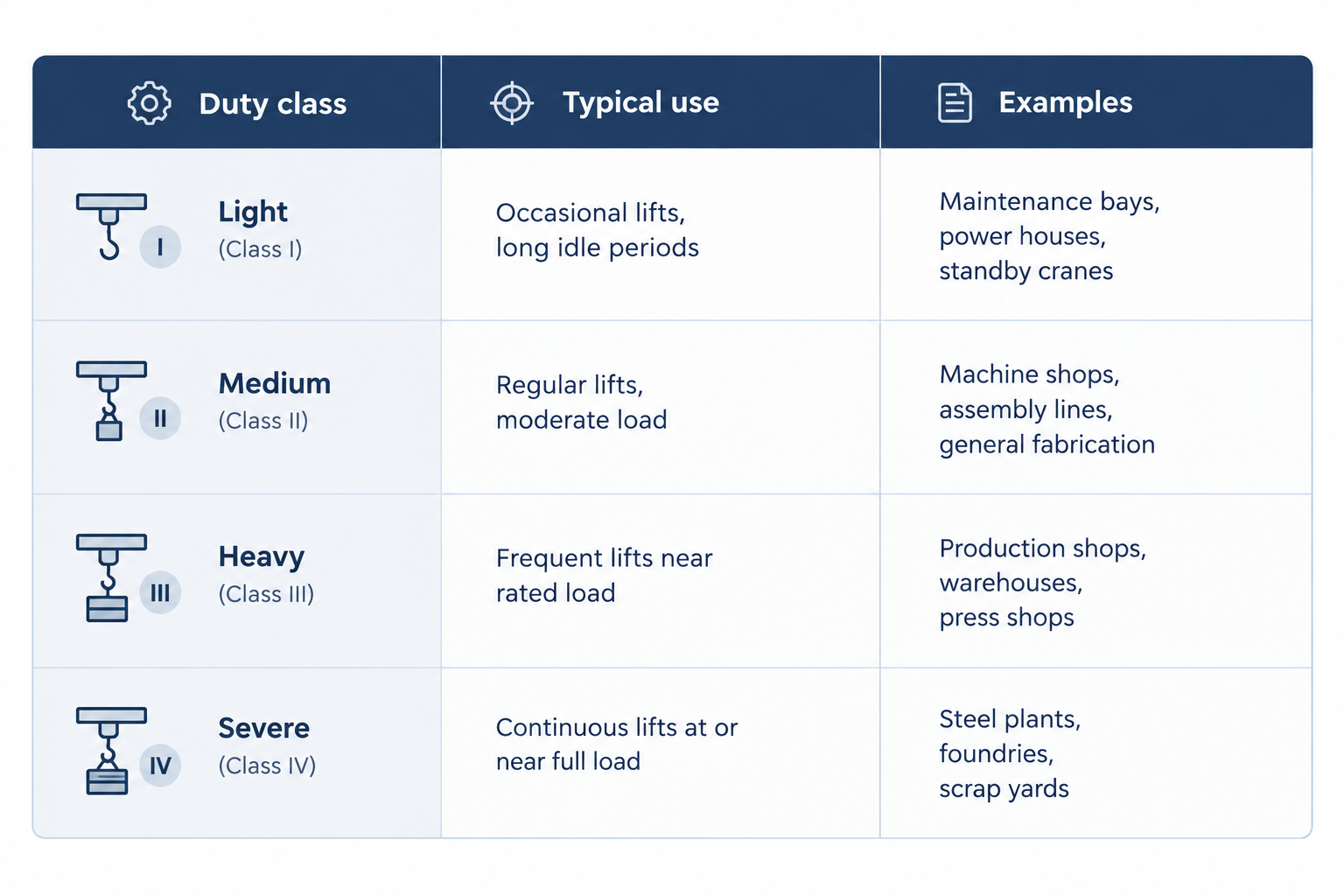
To choose a class, collect these figures:
- Lifts per hour and hours per day: A crane doing 30 or more lifts per hour needs a higher class than one doing 5.
- Load spectrum: Note whether the crane lifts light loads most of the time or runs close to rated capacity on most cycles.
- Motion mix: Record how often hoist, cross travel and long travel run together.
- Speeds: Typical main hoist speeds run from 4 to 8 m/min, cross travel from 10 to 20 m/min and long travel from 20 to 40 m/min. Faster speeds raise the class demand on brakes and drives.
- Control type: A VFD gives soft starts, reduces load swing and lowers wear on brakes, gearboxes and wheels. It is worth adding on any crane used for precision placement or high cycle counts.
- Maintenance access: Brakes, limit switches, rope drums and panels need safe access from the walkway or a maintenance platform.
How Macroverse Evaluates a 10/10T EOT Crane Application
For a recent 10/10 T EOT crane project, Macroverse started with the process before choosing any component.
- Industry and application: industry and what the crane lifts
- Capacity, span and lifting height: 10/10 T, span in m, hook height in m
- Duty class: class and lifts per hour
- Challenge: For example continuous-duty operation, limited headroom, high ambient temperature]
- Features added: For example VFD on all motions, overload limiter, dual brakes
- Result: For example hours of operation without unplanned downtime
Send your lifts per hour, load type and shift pattern to the manufacturer's technical team before you order. They can then set the duty class against your real operation.
5. Custom vs Standard EOT Crane Cost in India: What Drives the Price
Customization does not always raise the price sharply, and a standard crane is not always the cheapest option. These four factors move the quotation most, roughly in this order.
1. Capacity, span and duty class
These set girder size, hoist size, motor power and the weight of steel. A double girder crane costs more than a single girder crane of the same capacity, and a higher duty class adds cost through larger brakes, gearboxes and motors.
2. Specialized engineering and fabrication
Low-headroom designs, non-standard spans, tandem hoists and special lifting attachments need extra calculations, drawings and fabrication time.
3. Environment and safety requirements
Heat protection, outdoor protection and hazardous-area equipment add cost through special motors, cables, enclosures and coatings.
4. Controls and drives
VFDs, radio remote controls, anti-collision systems and automation features add to the initial cost. Choose them for the risks and precision your operation needs. Do not add them by default.
Runway strengthening, difficult site access and a tight erection window can also change the final project cost, so include them in your comparison. Ask each supplier to separate the crane, customization, structural work, installation and commissioning costs.
Discuss Your EOT Crane Requirements
Planning a new crane or evaluating custom EOT cranes for your plant? Share your application details with Macroverse Industrial Solutions and our team will recommend a configuration.
Discuss Your EOT Crane Requirements
6. How to Evaluate the Total Cost of an EOT Crane
The purchase price is one part of the cost. Compare these items across proposals.
Installation and commissioning
Check that the quotation covers erection, alignment, power feed, testing and commissioning. Confirm who supplies the crane for erection, and who pays for access equipment and site power.
Structural and runway work
Have a structural engineer check the existing runway beams, columns and foundations against the new wheel loads. Strengthening and civil work can be a large cost if found late.
Components and controls
Compare the hoist make and model, motor ratings, brake type, drive type, limit switches, overload protection and power feed method (DSL or festoon). Two quotes with the same tonnage can differ widely in what they include.
Spare parts and service
Ask which parts are stocked locally, what the lead time is on brakes, rope, wheels and electricals, and who provides breakdown support.
Maintenance
Ask for the recommended inspection schedule covering lubrication, brake lining wear, wire rope condition, limit switch function and electrical checks. Ask whether an annual maintenance contract is available.
A higher quotation may include components your duty class requires. A lower one may leave out items you will pay for later. Compare scope, component make, installation responsibility and service terms before you compare price.
7. EOT Crane Safety and Compliance in India: IS Standards and Factories Act Checks
A crane is not compliant simply because it lifts the rated load. Check these areas before you approve a proposal.
Standards and statutory requirements
In India, the main references are:
- IS 3177: code of practice for electric overhead travelling cranes and gantry cranes
- IS 807: design, manufacture, erection and testing of cranes and hoists
- IS 3938: electric wire rope hoists
- Factories Act, 1948: provisions for lifting machines, which require testing, examination and records
- State Factories Rules: specific test loads, inspection intervals and registers
Ask the supplier which standards the crane is designed to, and confirm the current editions with your safety team.
Safe working load marking
The safe working load (SWL) must be clearly marked on the crane. The operating procedure should prohibit lifting beyond that load.
Safety devices
Specify and verify these devices:
- Overload limiter on the hoist
- Upper and lower hoist limit switches
- Cross travel and long travel limit switches with buffers
- Emergency stop on the pendant or remote and on the main panel
- Audible warning (hooter) and, where needed, anti-collision for multiple cranes on one runway
- Rail clamps or storm anchors for outdoor cranes
Runway and structure
A qualified structural engineer should verify the runway beams, columns, fixings and rail alignment for the crane's wheel loads and duty class.
Load testing and examination
Before first use, the crane is load tested at a value above its SWL, set by the applicable standard and state rules. A common practice is a static test at 125% of SWL and a dynamic test at about 110% of SWL. After that, a competent person must examine the crane at the intervals the Factories Act and state rules require, and the results must be recorded in the prescribed register. Wire ropes, hooks and lifting tackle usually need more frequent examination than the crane structure.
Maintenance and inspection
Set a routine of daily operator checks, periodic maintenance by trained staff and a yearly examination by a competent person. Watch these wear points: brake lining, wire rope (broken wires, reduced diameter, corrosion, kinks), hook throat opening, wheel flanges and rail wear.
For a custom design, also request the design calculations, general arrangement drawings and the test certificates for the modified parts.
8. What Information Should You Prepare Before Requesting an EOT Crane Quote?
Complete data gets you an accurate quotation on the first round. Use this checklist.
- Capacity: Maximum load, including the lifting beam, sling and attachments.
- Span: Distance between runway rail centres.
- Lifting height: Required hook height from the floor, plus clearance under the roof truss.
- Duty cycle: Lifts per hour, hours per day and the typical share of rated load.
- Load type: Size, shape, weight and how you attach it.
- Headroom and hook approach: Distance from rail top to the lowest roof member, and the minimum distance from the hook to the end walls.
- Runway details: Existing beam size, column spacing, rail section and drawings, or a note that the runway is new.
- Environment: Indoor or outdoor, ambient and radiant temperature, dust, moisture, chemicals and any hazardous zone.
- Controls: Pendant, radio remote or cabin, single speed, two-speed or VFD, and any integration needs.
- Site and timeline: Location, access for trailers and cranes, power supply and target commissioning date.
Attach a building layout, a general arrangement drawing or photographs of the bay. This often reveals clearance problems early.
Need Help Preparing Your Requirements?
Gather the details above, then send them to Macroverse Industrial Solutions. We will confirm the scope of supply and list any open technical questions.
Download the EOT Crane Requirements Checklist
9. Choosing an EOT Crane Manufacturer in Chennai
Pick a manufacturer on how well it understands your application, not only on price. Look for these signs.
- Application questions: The supplier asks about load, duty cycle, headroom, environment and runway before it proposes a crane.
- Engineering capability: The team explains girder design, hoist selection, duty class and structural interfaces in plain terms.
- Installation and commissioning: The supplier states who erects, tests and commissions the crane and which documents you receive at handover.
- After-sales support: The supplier provides a maintenance schedule, local spares and a response time for breakdowns.
- Quotation clarity: The quote lists capacity, span, lifting height, duty class, speeds, controls, safety devices, exclusions and responsibilities.
- Relevant experience: The supplier has built and commissioned cranes in similar industries and duty classes.
Macroverse Industrial Solutions manufactures industrial cranes and supports customers across Tamil Nadu and India with crane selection, installation and service. To see our range, visit our Cranes Manufacturer in Chennai page.
11. Conclusion: Choose the EOT Crane That Fits Your Application
Start from your actual lifting process. If a standard crane matches your capacity, span, hook height and duty class, buy it and save the cost and lead time of custom work. If your headroom, load, environment or duty class falls outside the catalogue, specify custom EOT cranes and document what each change is for.
Compare quotations on scope, component make, duty class, safety devices, installation and service. Confirm the applicable standards and test requirements with your safety team before you approve the order.
Planning an EOT crane installation or evaluating custom EOT cranes?
Share your capacity, span, lifting height and duty requirements with Macroverse Industrial Solutions, and our team will recommend the right configuration.
