


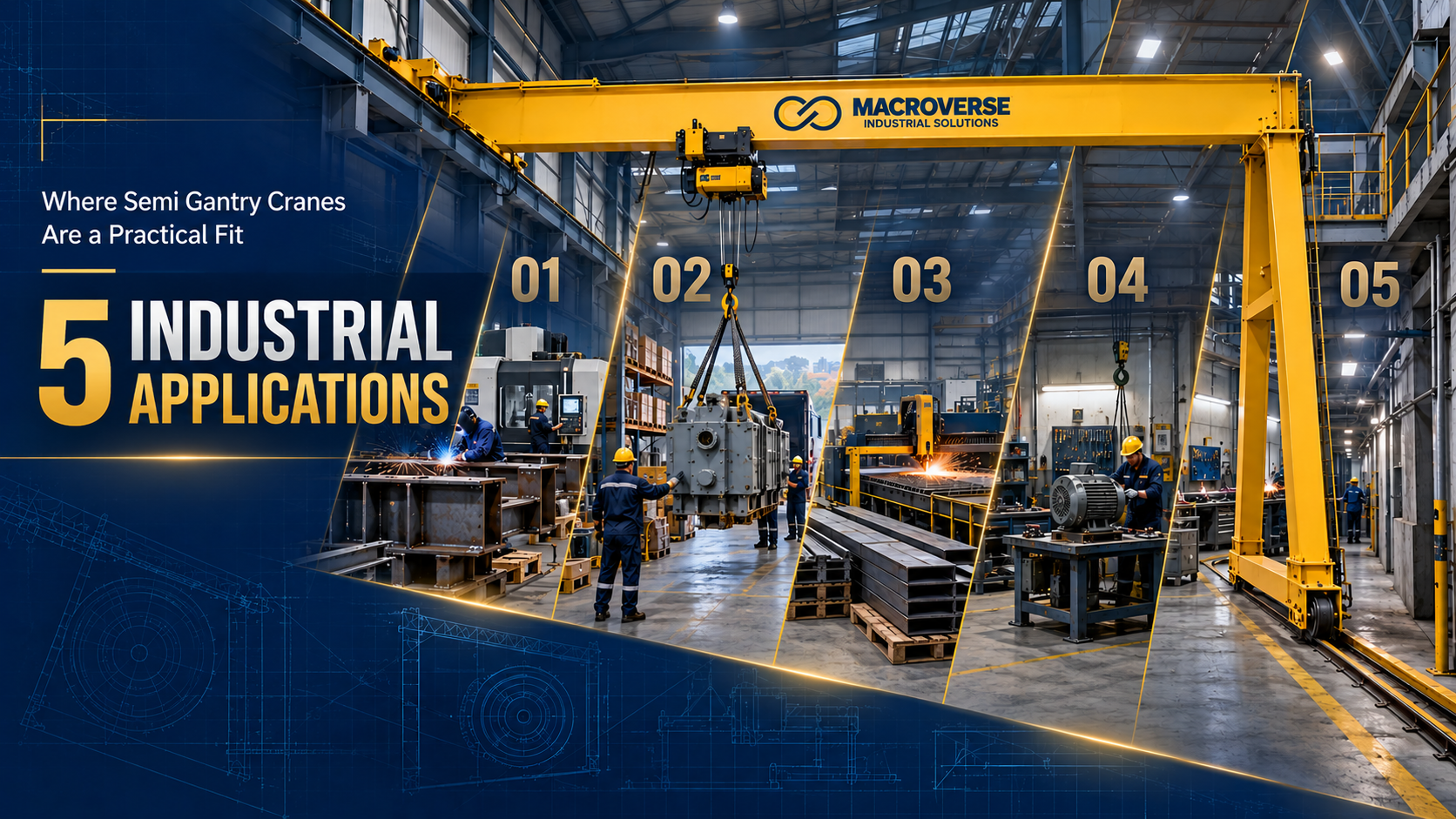
5 Industrial Applications Where Semi Gantry Cranes Are a Practical Choice
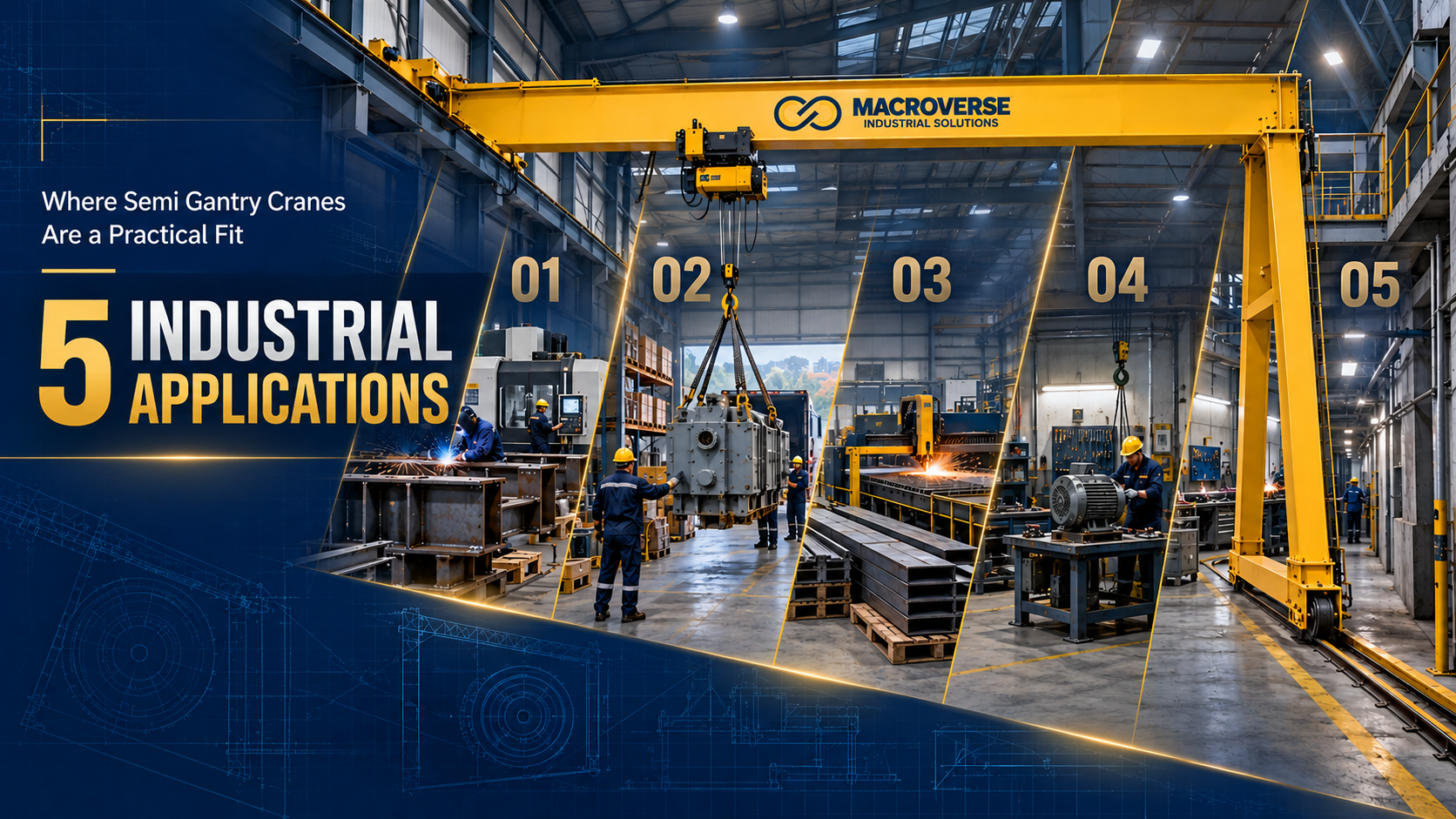
5 Industrial Applications Where Semi Gantry Cranes Are a Practical Choice
In a growing manufacturing facility, production may need to expand into the next bay. However, adding another full overhead crane can require new runway beams, additional columns, and structural modifications that the existing building may not be designed to support. A semi gantry crane solves this: the bridge rides on the existing runway on one side, with end trucks on a floor-mounted gantry leg on the other, so the new bay gets coverage without a matching runway.
Choosing between an EOT crane, a full gantry crane, or a semi gantry crane isn't just about the load to be lifted. It depends on the available building structure, floor space, existing crane infrastructure, required span and lifting height, load characteristics, frequency of lifting, installation constraints, and budget.
Here are five industrial settings where a semi gantry crane is a practical fit, and what to check before installing one.
5 Industrial Applications of Semi Gantry Cranes
1. Manufacturing & Engineering Fabrication
Application
In manufacturing environments, these systems are used to position weldments, castings, and machined housings between CNC stations and assembly jigs. They also support the loading of heavy gearbox housings, forgings, and fixtures onto machining centres. During in-line assembly, they can lift sub-assemblies such as frames and pressure vessels, while also helping operators rotate or flip fabricated weldments for multi-side welding access.
Why it's practical
- Shares the existing runway beam instead of requiring a second beam and column line
- Uses a lower duty classification for intermittent fabrication lifts, rather than the higher duty class continuous production would need
- Keeps the gantry leg clear of CNC infeed/outfeed paths and fixture staging areas
- Works well with a single girder for most fabrication loads, minimising headroom loss under the bridge
Installation considerations: Before installation, the facility should review:
- Runway beam capacity and wheel loading, to confirm it can take the added end truck reaction on the existing side
- Column spacing along the runway, which sets the achievable span
- Gantry leg foundation and base plate sizing on the floor-supported side
- Floor bearing capacity at the leg footing
- Hook height clearance over the tallest fixture, jig, or machine on the line
- Duty cycle, if the crane will run near-continuously through a shift rather than intermittently
Recognising when an existing production layout suits this configuration, rather than a completely new overhead system, is a useful starting point for planning.
2. Warehousing & Heavy Component Handling
Application
In warehousing and heavy component handling environments, these systems can unload transformers, gearboxes, and die sets from flatbed trailers at the dock. They also help move coils, ingots, and palletised castings between receiving areas and storage racks. For nearby production or press lines, tooling and dies can be staged for faster changeovers. They are particularly useful for handling concentrated loads that are too heavy or awkward to move safely with a reach truck or counterbalance forklift.
Why it's practical
- Handles concentrated point loads, such as a transformer or coil, that a reach truck or counterbalance forklift isn't rated to carry
- Fits within an existing aisle without needing a second column line for a full runway
- Keeps the hook and load path clear of rack beams and overhead sprinkler lines
- Runs at a travel speed matched to dock and receiving cycle times, rather than warehouse-wide travel
Installation considerations Planning should account for:
- Aisle centre-to-centre width against required hook travel and end approach clearance
- Rack beam and sprinkler head clearance along the hook and load path
- Floor loading at the dock or receiving bay, where the gantry leg will sit
- Runway beam tie-in on the building side, if using an existing wall or column line
- Duty classification suited to receiving frequency, since dock cranes often see more starts and stops per shift than production cranes
Aisle width and rack layout, more than raw lifting capacity, usually decide the crane span here.
3. Steel & Metal Processing
Application
In steel and metal processing facilities, these systems support the movement of steel plate and billet stock into shears, plasma or laser cutting tables, and press brakes. They can also handle the loading and unloading of coil stock at slitting or pickling lines. Fabricated steel assemblies, including trusses and beams, can be moved efficiently between welding and shot-blasting bays, while offcuts and scrap can be safely handled within cutting and fabrication areas.
Why it's practical
- Matches a higher duty classification where cycle rates from shears, cutting tables, or press brakes run through a full shift
- Delivers controlled, repeatable lifts with below-the-hook tooling such as coil hooks, C-hooks, or lifting magnets, where mobile equipment can't hold the same approach precision
- Covers specific processing bays or stockyard sections rather than the full building
- Reduces the need for extensive overhead structural modifications, depending on the existing structure
Installation considerations Facilities should confirm:
- Required load capacity and duty classification, based on cycles per hour rather than just peak load
- Environmental protection for the hoist, controls, and electrics against dust, scale, and weld fume
- Required span and lifting height, including clearance around cutting tables and shot-blast enclosures
- Compatibility with the below-the-hook tooling the process requires, and its effect on load stability
Given the weight and frequency of loads typically involved, this application usually calls for a higher duty class than a general-purpose crane.
4. Industrial Workshops & Maintenance Areas
Application
In industrial workshops and maintenance areas, these systems support a range of repair and overhaul activities. They can be used to pull motors, gearboxes, and pump assemblies for servicing, lift engine blocks or transmission units during teardown, and position heavy tooling or dies on a workbench for repair. They also help support shaft or rotor removal during bearing replacement, making maintenance tasks safer and easier to manage.
Why it's practical
- Sized to the bench or teardown bay rather than the full building footprint
- Hook height set to match the lift a component actually needs, such as pulling an engine or gearbox clear of its mounts, not full building clearance
- Suits a lower duty classification for intermittent maintenance lifts
- Keeps the gantry leg clear of the vehicle or equipment access path into the bay
Installation considerations Before installation, review:
- Headroom above the tallest component likely to be serviced, such as an engine block on a stand
- Floor loading at the leg footing, particularly where service pits or trenches are nearby
- Travel path clearance from workbenches, service pits, and parts storage
- Hook approach to typical lifting points on the components handled
- Frequency of lifts, to size the hoist duty and motor rating correctly
Because the working zone is usually well defined from the outset, this tends to be one of the more straightforward applications to plan for.
5. Space-Constrained or Partially Covered Lifting Areas
This is arguably where the case for a semi gantry crane is strongest. It is particularly useful in facilities where a press shop or fabrication bay has been added alongside an existing line without a matching runway. It can also support lifting operations in tool rooms or maintenance bays created from previously unused floor space. In loading bays where a runway beam can only be installed on one wall, or in areas next to mezzanines and existing structures that cannot support runways on both sides, a semi gantry crane provides a practical lifting solution.
Why it's practical
- Needs only a new gantry leg foundation, rather than a full new column line and runway
- Sets the span to the actual width of the uncovered bay, instead of over-specifying to match an unrelated runway
- Avoids reinforcing the existing runway beam to carry a second full crane bridge
- Routes around specific structural constraints of the facility, such as a nearby mezzanine or roof structure
It's worth noting that a semi gantry crane doesn't always reduce installation cost. What it can do is reduce infrastructure requirements and installation complexity, depending on the condition and layout of the existing facility.
Installation considerations Before installation, review:
- Structural assessment of the supporting side, including existing runway rating and column capacity
- New foundation design for the gantry leg, including floor slab and soil bearing checks
- Rail alignment tolerance between the fixed runway and the new gantry rail
- Clearance from walls, roof structure, and any services running through the bay
- Wheel loading and travel path at the transition between the runway side and the gantry leg side
Of the five applications covered here, this partial-coverage scenario is often the clearest case for choosing a semi gantry crane over a conventional overhead or full gantry system.
What Happens After 10 Years? Does the Crane Need to Be Replaced?
A crane reaching 10 years of service doesn't automatically mean it needs to be replaced. Service life depends on several factors working together, not simply the number of years in operation, including:
- Operating hours
- Duty classification
- Load cycles
- Maintenance history
- Structural condition
- Wear of mechanical and electrical components
- Condition of safety systems
- Availability of replacement components
Rather than defaulting to replacement, a lifecycle approach is generally more practical:
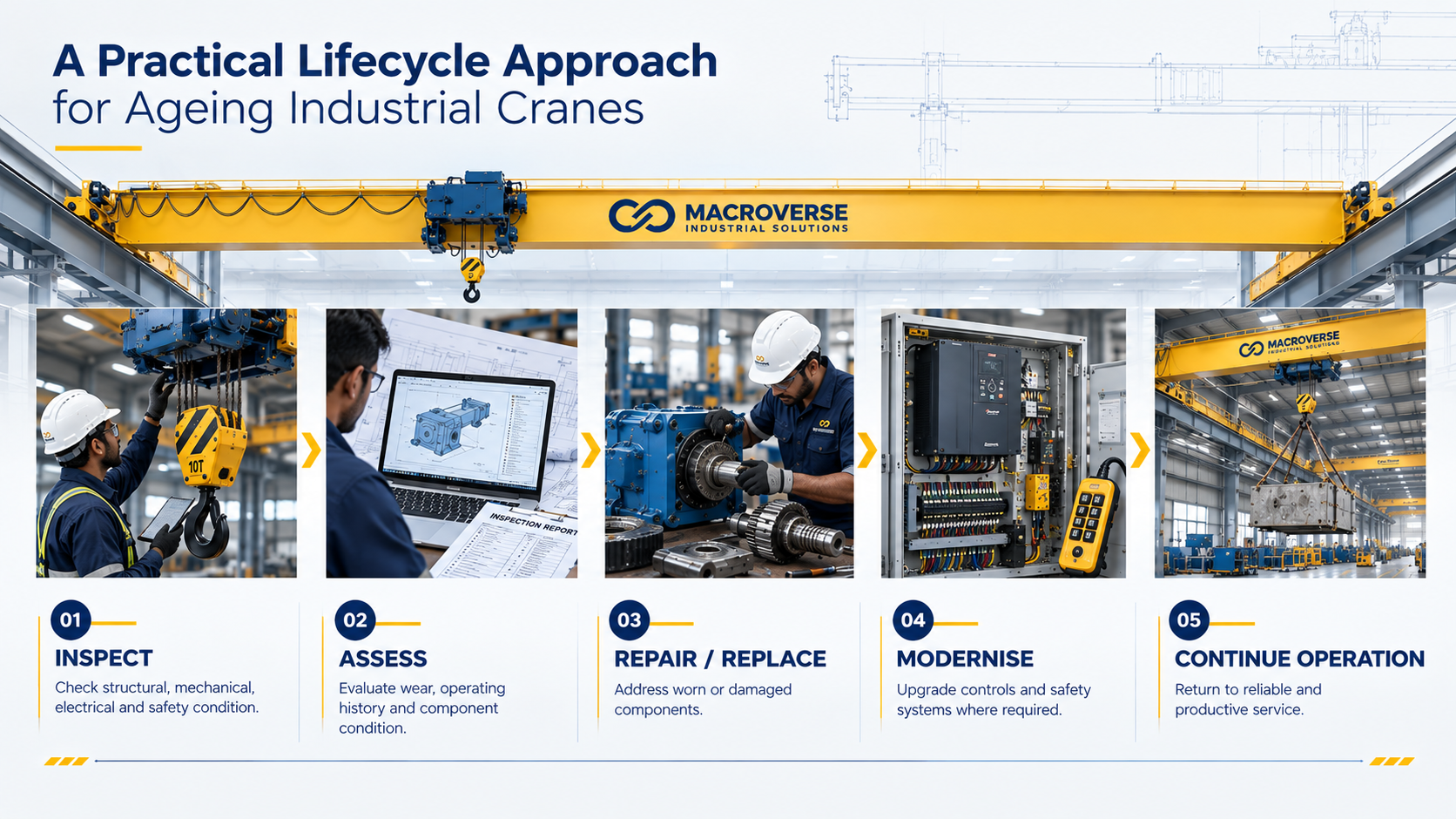
Modernisation can include upgrades such as:
- VFD drives
- Radio remote controls
- Updated limit switches
- Overload protection
- Wire rope or hoist chain replacement
- Control system upgrades
We'll cover these upgrades in more detail in an upcoming article, but it's worth knowing that ageing cranes often have more service life left in them than the years on record alone would suggest.
Why Customisation Matters When Investing in a Semi Gantry Crane
No two facilities have identical lifting requirements, which is why customisation plays a significant role in any semi gantry crane project. Rather than asking why customisation is needed, it helps to look at what actually gets customised.
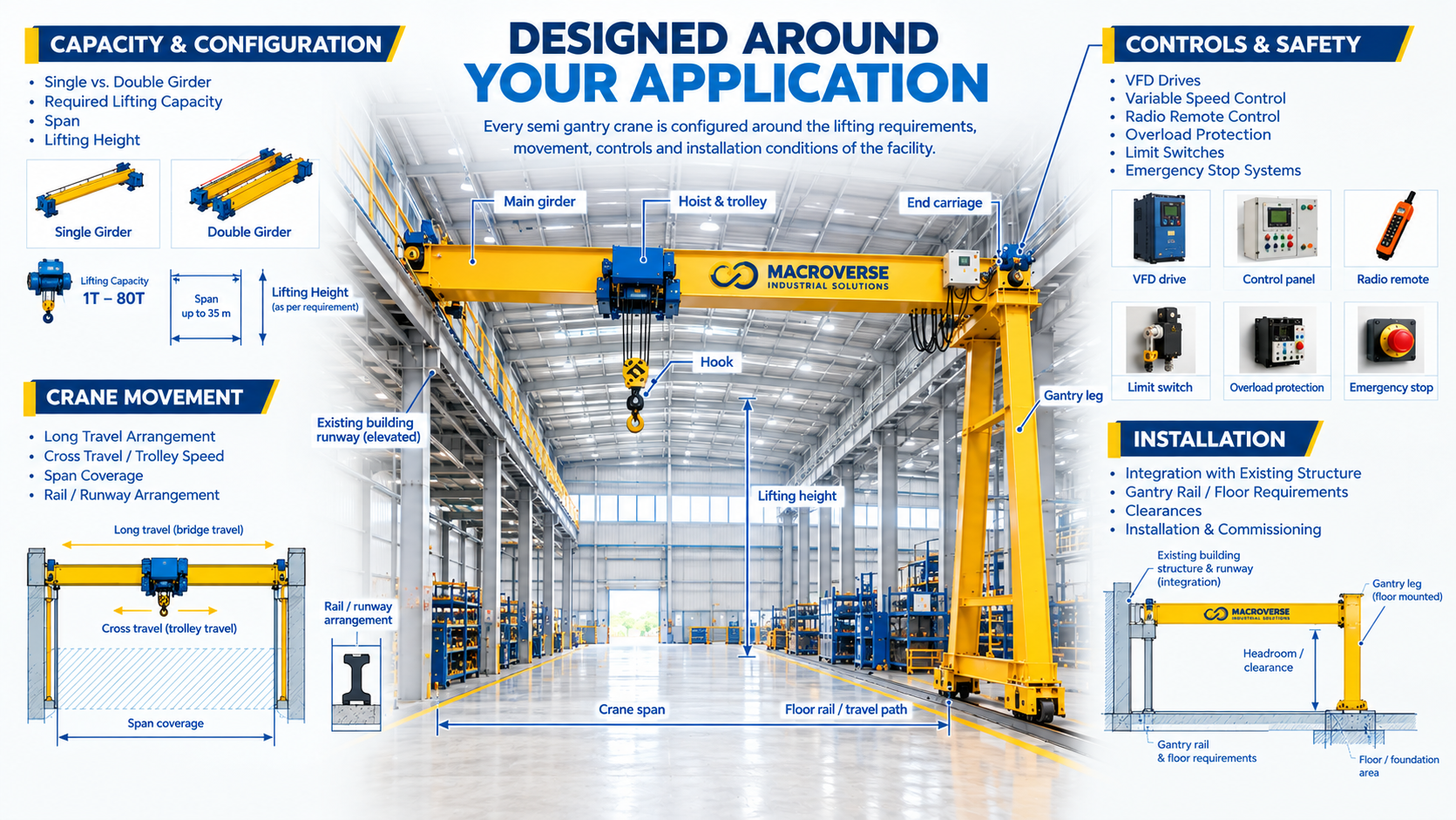
A customised crane isn't simply a standard crane with a few additional features. The configuration, controls, and supporting systems are selected around the actual lifting application and the specific requirements of the facility.
Macroverse designs semi gantry crane systems around these requirements, offering single and double girder configurations from 1T to 80T, along with controls, installation, commissioning, and lifecycle support.
Choose the Crane Around the Application
There isn't one crane configuration suitable for every facility. Semi gantry cranes can be a practical choice where lifting requirements, existing infrastructure, and space constraints make a conventional overhead or full gantry solution less suitable.
The right decision should weigh:
- Load
- Span
- Height
- Frequency
- Facility structure
- Installation requirements
- Future operating needs
Planning a semi gantry crane for your facility? Share your lifting capacity, span, lifting height, and application with Macroverse to explore a configuration suited to your operating requirements.