


Semi-Gantry Crane Trends in 2026: What Industrial Buyers Should Consider
Semi-Gantry Crane Trends in 2026: What Industrial Buyers Should Consider
Most crane enquiries start the same way: "We need something that lifts X tonnes over Y metres." That's a reasonable starting point, but it's rarely enough to spec a semi-gantry crane correctly, and it's not what's changed in how the better suppliers are approaching quotes this year.
Capacity and span tell a manufacturer what the equipment has to lift. They don't tell it how the equipment needs to live in your plant, how hard it'll be worked, or what's moving around it while it operates.
The gap between "meets the capacity" and "fits the operation" is where most post-installation problems come from.
Around 70% of cranes in use today are now being integrated with IoT and AI-driven systems for performance monitoring and predictive maintenance, cutting downtime by as much as 30%, according to market research from SNS Insider.
This shift toward smarter, better-monitored equipment is pulling the rest of the specification process along with it: duty class, facility condition, motion control, and safety scope are increasingly treated as part of the spec itself, not follow-up questions asked after a quote goes out.
If you're evaluating a semi-gantry crane in 2026, these are the areas worth looking at before finalising the specification."
01 · Duty Class Is Becoming a More Important Part of Crane Selection
Rated capacity is a ceiling, not a description of daily use. A crane rated for 10 tonnes that lifts 10 tonnes twice a shift is a very different machine from one lifting 8 tonnes forty times a shift: same capacity, completely different stress on the hoist motor, brakes, and structural components over time.
This is what duty classification exists to capture, and it's worth naming the standards explicitly rather than treating "duty" as a vague checkbox. CMAA ranks cranes Class A through F; FEM 1.001 uses groups 1Bm through 8m; and ISO 4301 uses its own M-class scale, M1 through M8. All three rank cranes by a combination of load spectrum and number of operating cycles over the equipment's design life, not just peak tonnage. In India, IS 3177 sits alongside these as the underlying design and construction code that a duty class gets engineered against, rather than a duty scale in its own right.
To classify correctly, your crane engineer needs:
● Typical working load, not just maximum load
● Load spectrum (what % of lifts are near max capacity vs. light loads)
● Number of lifting cycles per shift/day
● Operating hours and shift pattern
● Cyclic duty factor (ED%) if the crane will be used intermittently at high intensity
Get this wrong in either direction and it costs you. Over-spec the duty class and you're paying for structural and drive capacity you'll never use. Under-spec it and components (brakes, gearboxes, wire rope) wear out faster than their rated service life, and you end up doing unplanned maintenance on a crane that's barely a year old.
What's actually changed by 2026: more suppliers now ask for load spectrum and cycle data before they'll quote a duty class at all, instead of defaulting to a standard class based on tonnage alone. Buyers who show up with that data get a tighter, more defensible spec; buyers who don't are increasingly asked to go get it first.
Ask your supplier: "What duty class are you designing to, and what load spectrum data did you base that on?" If the answer is just "it's rated for 10T," that's a capacity answer to a duty question.
02 · Your Facility Is Now Part of the Quote
A semi-gantry crane is unusual among overhead handling equipment because it's a hybrid by design: one end typically rides an elevated runway (building-supported or freestanding), the other runs on a floor-mounted rail. That means the crane spec is only half the story. The other half is an engineering review of the structure it will live in.
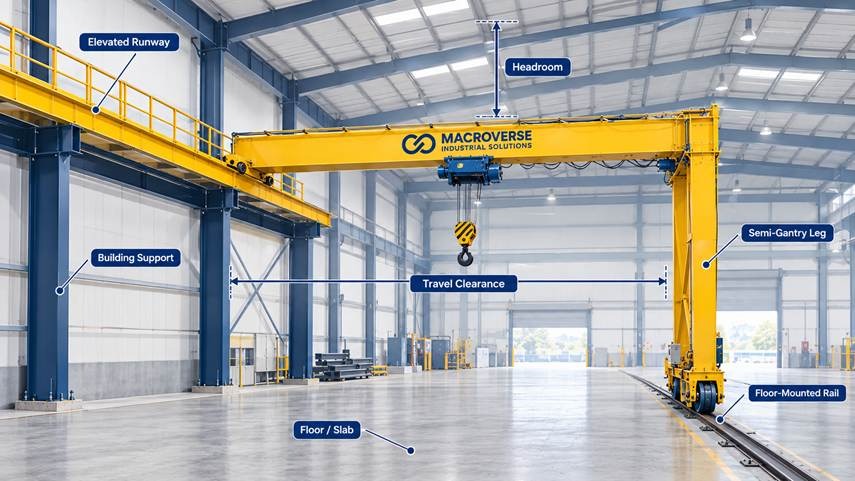
The parts of the structure a semi-gantry crane depends on: half the spec is the building it lives in.
Before configuration, someone needs actually to check:
● Runway condition and load rating, if one already exists
● Floor slab condition where the rail will sit (thickness, reinforcement, load-bearing capacity)
● Rail alignment tolerance and anchoring method
● Wheel loads the new crane will impose, and whether existing supports can take them
● Available headroom, including hook approach distances, which is where crane dimensions most often surprise people after the fact
● Travel path clearance against columns, existing machinery, ductwork, sprinkler lines
Skip this step and you'll find out about it during installation, which is the most expensive place to find out. A crane can meet every capacity and span requirement on paper and still need floor modification or runway reinforcement once someone measures the actual site.
This is also where quoting has moved earlier: a site survey used to be something a manufacturer's team did after a purchase order was signed. More suppliers now ask for it, or a version of it, before they'll finalize a proposal, because too many post-sale change orders have come from specs built on assumed rather than measured site conditions.
Worth doing before you request a quote: a basic site survey, even just photos and a rough floor plan with column spacing and headroom measurements, so the manufacturer's engineering team is designing against real numbers, not assumptions.
03 · Controlled Motion Is Becoming an Application-Level Decision
Variable frequency drives get specified on a lot of cranes almost by default now, and sometimes that's the right call. Sometimes it's paying for precision the operation doesn't need.
VFD control earns its cost when the crane is:
● Positioning loads accurately near fixed machinery or tight tolerances
● Operating in a confined travel area where soft acceleration/deceleration matters for load stability
● Running frequent start-stop cycles where mechanical wear from abrupt braking adds up
● Handling loads sensitive to sway or sudden movement
Where it's less necessary: simple point-A-to-point-B transfers with open floor space, low cycle frequency, and no positioning tolerance requirement. In those cases, single-speed or two-speed control does the job at a lower cost and with less to maintain.
Practically, VFD can be applied selectively rather than across the board: hoisting only, cross travel only, or full three-motion control, depending on where precision actually matters in the cycle.
The trend worth flagging: VFD has quietly shifted from a premium option to something close to a default inclusion on new quotes, even when the application doesn't strictly need it. That makes the real question less "VFD or not" and more where in the cycle it's worth paying for, since full three-motion control on a simple point-to-point transfer is often cost added without a matching benefit.
Ask this: where in the operating cycle does control precision create real value, and where is it just added cost?
04 · Safety Scope Is Becoming an Expected Ask
Base-level protection (overload protection, hoist and travel limit switches, emergency stop) is standard on any properly built crane and shouldn't need negotiating. What does need site-specific thinking is everything beyond that baseline, because it depends entirely on what else is moving in the crane's operating area.
A crane working in a dedicated, fenced handling bay has a very different risk profile from one traveling through an active production floor with forklifts, AGVs, and personnel crossing its path regularly. Relevant standards here include OSHA 1910.179 (US) and IS 807 / IS 3177 provisions for overhead cranes, which set baseline requirements. The additional protection layer beyond that is a judgment call based on the actual environment:
● Anti-collision systems, if multiple cranes share a runway
● Radio remote control, to keep the operator clear of the load path
● Audible/visual travel warnings where AGVs or foot traffic cross
● Load moment indicators or overload alarms tied to specific process risks
This layer of safety design is getting less optional by the year. As more floors mix cranes with AGVs and higher foot traffic, anti-collision systems and travel warning devices are moving from a negotiated extra toward something buyers are expected to ask for by default, rather than something a supplier volunteers only if pressed.
Ask this early, not at commissioning: who and what shares this crane's travel path (people, forklifts, AGVs, other cranes), and has that been factored into the safety system, or just the crane itself?
05 ·Lifecycle Support Is Becoming a Pre-Purchase Question
A crane purchase decision is also, implicitly, a decision about who supports the equipment for the next 15 to 20 years. That's worth treating as part of the spec conversation, not an afterthought once something breaks.
Before signing off, it's worth having clear answers on:
● Who handles installation and alignment, and what tolerance they're working to
● Testing and commissioning process, and what documentation you'll receive
● Statutory inspection requirements and frequency for your region
● Preventive maintenance schedule and who performs it
● Genuine spare parts availability and lead times
● Whether an AMC (annual maintenance contract) is offered, and what it covers
Installation and alignment quality in particular has an outsized effect on long-term performance. A crane installed slightly out of alignment will show it in wheel wear and rail stress long before it shows up as a visible fault.
Buyers are also asking these questions earlier than they used to. Spares availability and AMC terms used to come up after a breakdown; now they're increasingly part of the initial proposal conversation, alongside duty class and safety scope, rather than something negotiated separately once the crane is already running.
What Should Buyers Look for in a Semi-Gantry Crane in 2026?
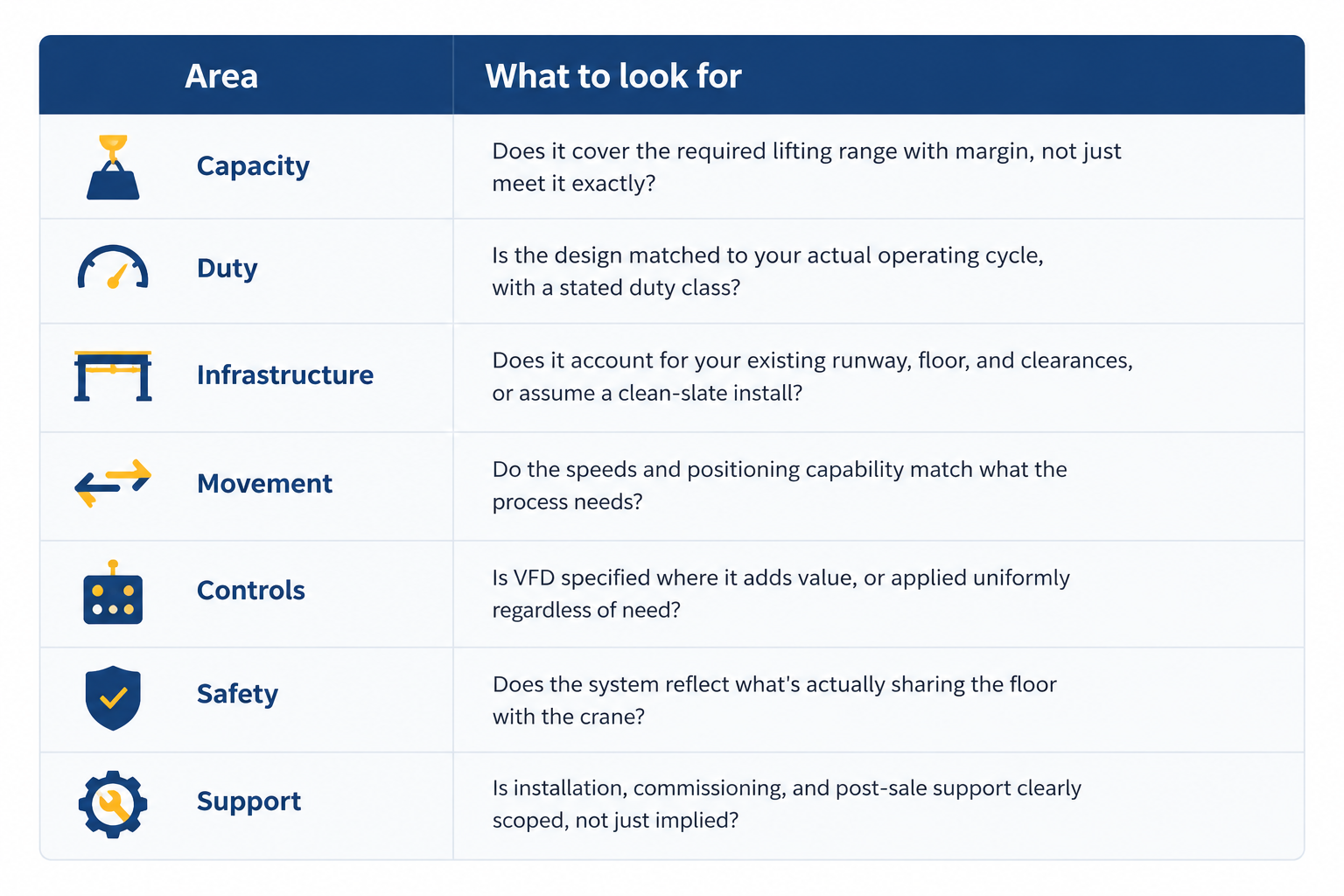
Two proposals against the same capacity and span can differ substantially once duty class, controls, and safety scope are actually specified.
If you're preparing to approach manufacturers, here's the shorthand version of everything.
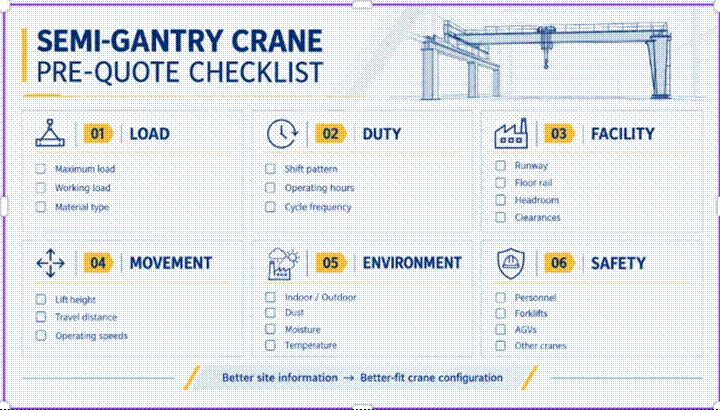
Bring this to a manufacturer and the conversation moves from "can you build something this size" to "here's how this needs to perform," which is a better conversation, and it's the one that actually produces a crane that fits.
What a Strong Proposal Should Address
When proposals come back, don't just compare price. Check that each one actually answers:
Macroverse approaches semi-gantry crane selection around the application's actual requirements, with single and double girder configurations, capacities from 1T–50T, VFD-controlled motion where required, and application-specific safety options. Its project support extends from design and manufacturing through installation, testing, and commissioning, with AMC and genuine spare-parts support after installation.
Planning a semi-gantry crane installation?
Macroverse's engineering team works from your actual duty cycle, facility conditions, and safety requirements, not just capacity and span, across single and double girder configurations from 1T to 50T, with VFD control and application-specific safety systems where they're warranted. Support covers design through installation, testing, commissioning, and ongoing AMC and spares
