


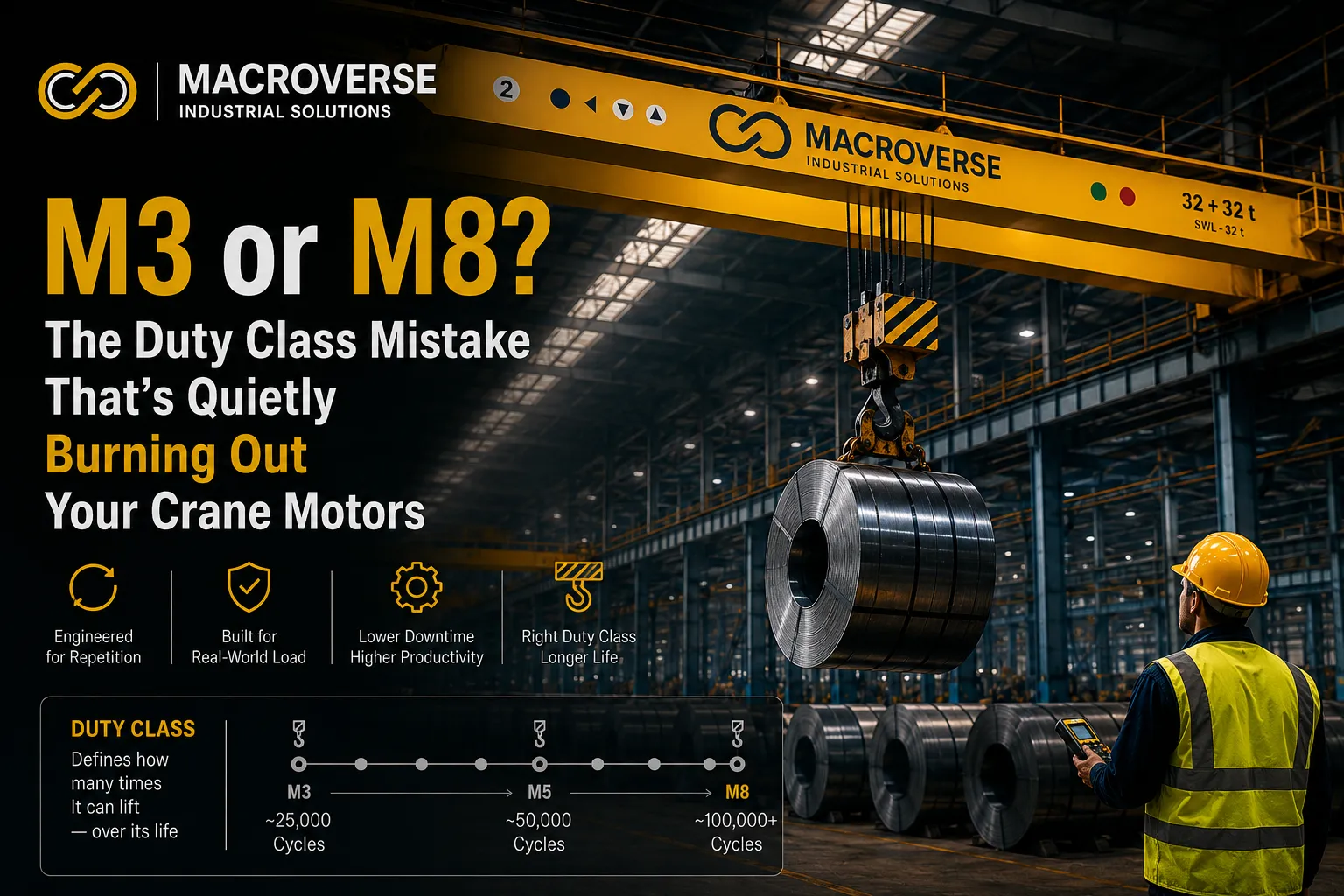
M3 or M8? The Duty Class Mistake That's Quietly Burning Out Your Crane Motors
Most crane buying conversations start and end with one number: tonnage. "We need a 10-ton crane." "Can it handle 20 tons?" It's a natural place to start, but tonnage only tells you what a crane can lift once. It says nothing about how many times it can lift that load, how often, and for how long, before something fails.
That second question is answered by duty class, and at Macroverse Industrial Solutions, it's the single most overlooked factor we see in industrial crane procurement. Get it wrong, and you don't get a crane that "sort of works." You get one that burns out motors, cracks welds, or needs major overhauls years ahead of schedule, no matter how good the tonnage rating on the nameplate looks.
What Duty Class Actually Measures
Duty class isn't about static capacity, it's about fatigue endurance. Two cranes can carry the exact same 10-ton load, but one is engineered to do that lift 25,000 times over its design life, and the other 100,000 times. The higher-duty crane uses thicker flanges, higher-grade steel, better weld quality, and motors sized to avoid overheating under repeated starts and stops. The lower-duty crane simply isn't built to take that kind of repetition, and it will show it, just not on day one.
This is formalized in international standards:
- FEM 9.511 (Europe) and ISO 4301-1 (international) classify cranes from M1 to M8, based on the total number of working cycles expected over the crane's design life and the load spectrum, essentially, how heavy the typical lift is relative to maximum rated capacity.
- CMAA Specification 70 (used in North America) expresses the same idea using letter classes, A through F.
- IS standards issued by the Bureau of Indian Standards classify hoists and cranes into five duty classes, I through V, based on duty severity and operating time, giving Indian buyers a direct, locally applicable reference point.
Different naming conventions, same underlying question: how hard, and how often, will this crane actually work?
Where Buyers Get It Wrong
The mistake almost always happens the same way. A plant manager or procurement lead sizes a crane purely on maximum load and available budget, without mapping out real operating patterns: lifts per hour, hours per shift, and how close to full capacity those lifts typically run. Two facilities can each buy a "10-ton crane" and end up with completely different real-world outcomes, because one runs occasional heavy lifts and the other runs the crane in near-constant rotation, several shifts a day.
The result of under-classifying:
- Premature motor burnout: motors are pushed past their duty factor, overheating on repeated starts
- Structural fatigue: welds and girders develop cracks years before they should, because they were never designed for that many load cycles
- Frequent unplanned downtime: the very thing the crane was bought to prevent
The reverse mistake, buying a much higher duty class than the application needs, isn't dangerous, but it's an unnecessary capital expense. Matching duty class correctly is as much a cost-efficiency question as it is a safety one.
A Practical Way to Think About It
Before specifying a crane, it helps to map out three things honestly:
- How many lifts per hour, on average, during peak production, not best-case, but typical busy-shift numbers
- How close to rated capacity those lifts usually run: a crane that's almost always lifting near its maximum load needs a heavier duty class than one that occasionally handles a full load but mostly moves lighter items
- Total operating hours per day, across all shifts
A steel fabrication shop running two shifts, lifting steel beams dozens of times an hour at 80 to 100% of capacity, sits in a very different duty class than a warehouse doing occasional pallet moves at a fraction of rated load, even if both are nominally buying a "10-ton crane."
This is exactly the kind of detail worth putting in front of your crane manufacturer at the quotation stage, not after installation. At Macroverse, this is one of the first conversations we have with a new client: understanding actual lift frequency and load spectrum, not just tonnage, before we recommend a duty class. It's the difference between a crane that lasts its full design life and one that needs major component replacement within a few years.
The Real Cost of Getting This Right
Duty classification doesn't show up on a spec sheet in a way that's easy to compare at a glance, which is exactly why it gets skipped in fast procurement decisions. But it directly determines two things every plant manager cares about: how often the crane needs unplanned maintenance, and how many years it delivers before major components need replacing.
Before finalizing a crane purchase, it's worth asking your manufacturer directly:
- "Based on our actual lift frequency and load spectrum, what duty class do you recommend, and why?"
- "What happens if we run this crane harder than the duty class it's built for?"
- "Can you walk us through the FEM/ISO or IS duty class this crane is built to, in plain terms?"
A manufacturer who can answer these clearly, with reference to your actual operating pattern rather than just your tonnage requirement, is one who's engineering for your facility, not just selling off a catalog.
Looking to get your crane specification right the first time? Macroverse Industrial Solutions has been engineering EOT cranes for manufacturing and industrial facilities across India since 2017, from our offices in Chennai, Bengaluru, and Hyderabad. Our engineering team can walk through your facility's actual lift patterns and recommend the right duty class for your application, not just the right tonnage