


How to Reduce EOT Crane Downtime: A Complete Maintenance Guide
How to Reduce EOT Crane Downtime: A Complete Maintenance Guide
An EOT crane down for four hours doesn't just cost four hours. It stalls the line waiting on material, the fabrication bay waiting on the next plate, the truck idling at the gate. This guide covers what actually causes EOT crane downtime, the standards behind inspection intervals, and where fixed-interval maintenance falls short.
Start With Duty Classification
Before any interval means anything, you need to know the crane's actual duty class. IS 3177 (aligned with FEM/ISO groupings) rates cranes from light, occasional use to continuous, near-capacity use, based on load spectrum and expected operating hours.
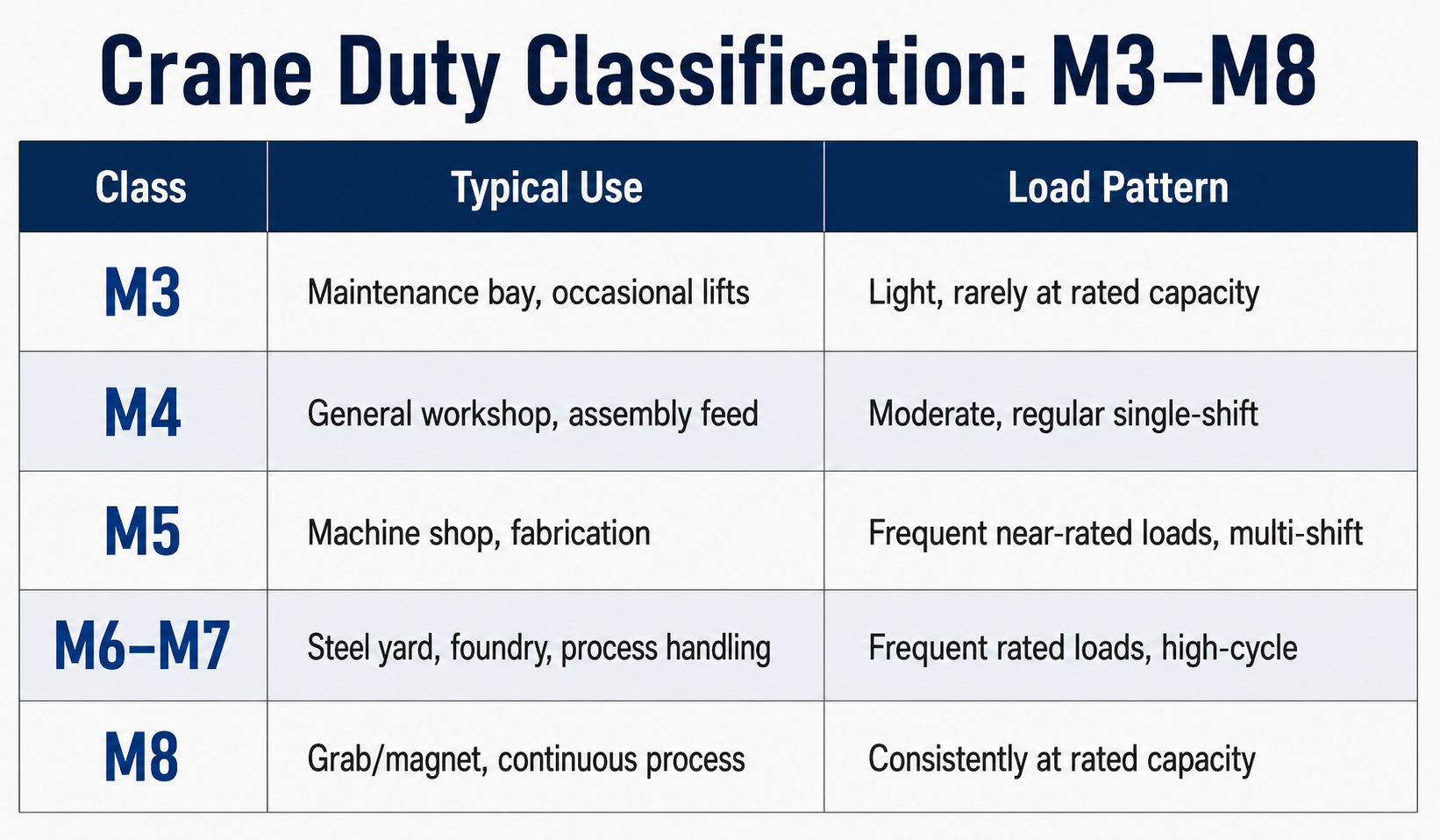
Two plants running the same tonnage crane can see very different failure rates if one runs M5-rated equipment at M7 duty. Copying OEM intervals written for a lighter duty class than your actual usage is the most common reason a "properly maintained" crane still breaks down early. Check the nameplate and design duty before setting anything below.
Measuring EOT Crane Downtime Properly
Planned downtime is scheduled PM, statutory inspection, and load testing. Unplanned downtime is everything else, and it's what actually hurts, since it hits mid-shift with no buffer.
Two numbers worth tracking:
- MTTR (Mean Time to Repair): repair hours ÷ number of breakdowns. Rising MTTR usually means spares aren't on-site.
- MTBF (Mean Time Between Failures): operating hours ÷ number of breakdowns. Falling MTBF flags a duty or interval mismatch before a major failure hits.
Most plants log "the crane broke down again" instead of fault type, repair time, and part replaced. Six months of the latter tells you more than any checklist. Indirect costs, idle labor, missed dispatch, and penalty clauses usually exceed the repair bill itself.
What Actually Causes EOT Crane Downtime
Wheel and rail wear. Slight misalignment accelerates flange wear on one side, then rail wear, then skewing during travel. Measure flange thickness against the OEM discard limit (commonly around 50% of original thickness confirm against your wheel drawing), don't eyeball it.
Wire rope fatigue. Rope degrades through broken wires per lay and diameter reduction, not sudden failure. IS 3177 sets discard criteria on both; roughly 7% diameter loss from nominal is a common trigger, but this varies by rope construction, so confirm against the current standard.
Gearbox oil degradation. Heat cycling breaks down oil viscosity quietly. Sample for viscosity drift, water content, and particle count rather than relying on a fixed change interval alone.
Brake torque drift. Hoist brakes are typically specified around 150% of rated load torque (verify against your brake's design data). A dragging brake heats the motor and wears linings faster; an under-torqued brake is a direct safety risk. Check with a torque wrench, not by feel.
Busbar and collector shoe wear. Uneven shoe wear causes arcing, which pits the busbar and shows up as intermittent power loss. Check for carbon tracking during weekly inspection.
Limit switch drift. Vibration and cycling shift calibration over time, causing nuisance stops (too early) or safety risk (too late). Recheck overtravel margin quarterly, not just at commissioning.
Festoon cable and contactor wear. Cable jackets crack at flex points before conductors fail. Contactors pit faster on cranes run with heavy inching; a megger reading trending down from baseline, even if still above the typical 1 MΩ minimum, flags a developing problem.
Girder camber loss and bearing failure. Repeated overload cycles flatten girder camber gradually, checked with a level against design reference points, not by eye. Ungreased or misaligned end truck bearings usually announce themselves as noise or vibration before they seize.
Process failures. Operators exceeding rated capacity, skipped daily checks, and poor rail housekeeping cause a large share of what gets logged as "mechanical" failure. No schedule fixes a routinely overloaded crane.
Maintenance Schedule (M4–M5 Baseline)
Tighten weekly items to twice-weekly and monthly to fortnightly for M6+ duty.
- Daily (operator): brake function, limit switches both directions, unusual noise, wire rope visual, pendant response, rail housekeeping.
- Weekly: flange thickness (calipers), collector shoe/busbar contact, festoon cable at flex points, hook/hook block condition, brake lining thickness.
- Monthly: gearbox oil level, contactor/panel condition, wire rope diameter at multiple points, walkway condition, load chart visibility.
- Quarterly: oil sampling, insulation resistance vs. baseline, brake torque vs. OEM spec, rail alignment vs. gauge/level tolerance.
- Annual (statutory): structural inspection with camber measurement, load testing, full electrical check, wire rope discard assessment, documentation signed by a competent person under the Factories Act, 1948.
Condition-Based Maintenance
Fixed intervals miss failures that develop faster or slower than the calendar assumes, and that gap is where a lot of unplanned EOT crane downtime actually originates.
- Vibration monitoring on hoist bearings, benchmarked against ISO 10816, catches wear before it's audible.
- Thermal imaging on panels and contactors flags loose connections; a delta-T of roughly 15°C above baseline is a common threshold worth investigating.
- Wire rope diameter tracking over time predicts replacement instead of reacting to it.
- Load cycle monitoring shows actual usage against design duty class, closing the gap described above.
Even a monthly handheld vibration reading, logged against the same bearing over time, beats a purely visual check.
Critical Spares to Stock
For M5+ duty cranes: brake shoes/linings, hoist and travel limit switches, contactors matched to the panel, a spare wire rope length, collector shoes, pre-cut festoon cable. Imported OEM electricals can have long lead times in India; confirm local availability before you need a part urgently.
Mistakes That Increase EOT Crane Downtime
These patterns show up repeatedly in plants with recurring breakdowns:
- Running wire rope past discard criteria because it "looks fine"
- Untrained staff bypassing limit switches to keep production moving
- Treating AMC visits as a signature exercise instead of a measurement log
- Ignoring flange wear until it damages the rail
- Skipping daily checks because "nothing's ever wrong"
- Copying OEM intervals without checking actual duty class against design duty
In-House vs. AMC
Depends on crane count and duty class, in-house access to a megger, thermal camera, and calibrated torque wrench, and how critical the crane is to the line. If a stoppage halts the whole line, a data-driven AMC usually costs less than even one unplanned multi-hour breakdown per quarter.
Macroverse, founded in Chennai in 2017 by Sudharshan M and Prasandh S, runs AMC and preventive maintenance for EOT, gantry, and jib cranes across Chennai, Tamil Nadu, and major industrial sectors in India, covering both their own cranes and other manufacturers' equipment. Their AMC includes IoT-enabled monitoring to predict failures before they cause a breakdown, along with digital inspection records instead of paper logs. Where a plant lacks the instrumentation or trained technicians for condition-based checks, an external AMC usually makes more sense than stretching an in-house electrician beyond their scope.