


How Much Does a Custom EOT Crane Cost in South India? Factors That Affect Your Quote
How Much Does a Custom EOT Crane Cost in South India? Factors That Affect Your Quote
An Electric Overhead Travelling (EOT) crane has no fixed price.
Two cranes with the same rated capacity can differ widely in cost because of span, duty class, controls, building conditions and installation scope. That is why we quote each custom EOT crane against the plant it will serve.
For plant heads, maintenance managers and procurement teams, the lowest initial quote rarely gives the best long-term value. A cheaper crane that is under-specified for its duty, or that comes with weak service support, usually costs more through repairs, downtime and early component replacement. This guide explains what drives the quote, how to estimate payback, and how to compare offers on total cost.
Macroverse designs, manufactures, installs and services overhead cranes for industries with 8 years of experience.
The advice below reflects how we scope custom EOT crane projects for plants in South India.
Key Factors That Affect Custom EOT Crane Costs
1. Capacity, Span and Lifting Height
Capacity sets the size of the hoist, the girder section and the runway load. Span drives the bridge structure: a crane for a compact workshop bay is built very differently from one crossing a wide fabrication shed. Lifting height decides the hoist arrangement and how much headroom you need.
Quote requests often go wrong on measurements.
For example, ideally, span should be taken between runway rail centres, not between columns.
Headroom should be measured from the rail top to the lowest obstruction, such as a roof truss, light fitting or pipe run.
You also need to include the weight of lifting attachments such as spreader beams or magnets in the rated load. Even small errors could surface at installation, at a time when they are expensive to fix.
2. Duty Classification and Operating Frequency
A crane that moves a die twice a shift has different demands from one feeding a production line for three shifts. Duty classification translates your workload into motor, brake, gearbox and structural requirements, and it is one of the largest drivers of price.
To classify the duty correctly, you must tell the manufacturer these things:
- How many hours and shifts the crane runs
- An approximate lifts made per hour
- What share of these lifts are at or near full load.
Selecting by capacity alone is the most common way to end up with a crane that wears out early.
3. Hoisting Speeds, Controls and Safety Systems
Speed and control choices affect both price and how the crane behaves in daily use.
Single-speed hoists cost less. Dual-speed hoists and variable frequency drives (VFDs) give smoother starts and stops, which matters when positioning heavy or delicate loads.
Pendant control suits many workshops, while radio remote control lets the operator stand where the load is visible.
Safety features such as overload protection, limit switches and anti-collision systems also add to the quote.
You need to match each feature to a real need. Paying for options your process does not use is as much a waste as leaving out protection it does.
4. Installation, Commissioning and Structural Modifications
The crane price does not always cover everything needed to put it to work. Existing buildings may need runway beam strengthening, new electrical supply or access arrangements, and these can change the project budget significantly.
Before you issue a purchase order, get written clarity on transport and erection, electrical connections, testing and commissioning, any civil or structural work, and handover documentation with operator training. A quote that looks lower often leaves several of these out.
How to Evaluate the ROI of a Custom EOT Crane
A custom EOT crane pays back by removing specific problems in your process. The most common are:
- Less waiting: Production stages stop sharing one lifting point, so bottlenecks ease.
- Faster movement: Fewer handling steps between workstations.
- Less manual handling: Suitable loads move by hoist instead of by hand or forklift.
- Better use of floor space: An overhead crane frees the floor that trolleys, forklifts and stacking zones would occupy, and a layout planned around the crane keeps material flow short.
Put numbers on these using your own plant data.
For example, record how many production hours are lost each month waiting for lifting equipment and what those hours cost. Count only savings that actually reach your accounts. An hour saved does not always become money saved.
Calculate the Payback Period
Annual Net Benefit = Annual Savings − Additional Annual Costs
Payback Period = Initial Investment ÷ Annual Net Benefit
Here is a hypothetical project:
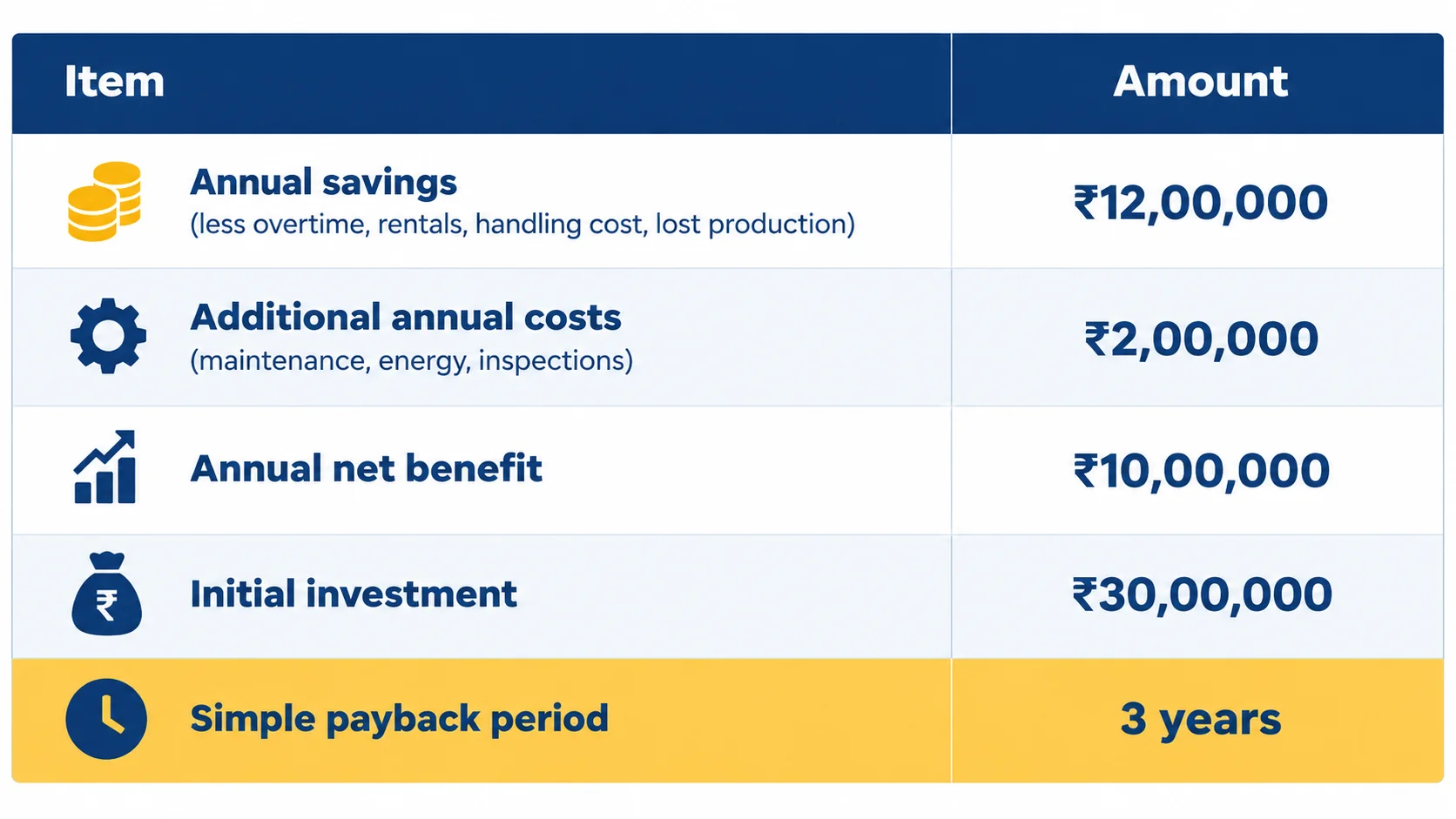
Illustrative figures only, not a Macroverse quotation. The calculation assumes steady savings and excludes financing and tax.
The question to answer is: Will the additional investment generate enough operational value to justify its cost? Compare the payback period with your company’s investment criteria and the crane’s expected service life.
Total Cost of Ownership (TCO)
The purchase price is only the first line of what a crane costs. Over its life you also pay for installation and commissioning, maintenance and spares, energy, component replacement, and the production lost when the crane is down. Adding these up over the same period is the only fair way to compare two quotations.
Here is a hypothetical 10-year comparison:
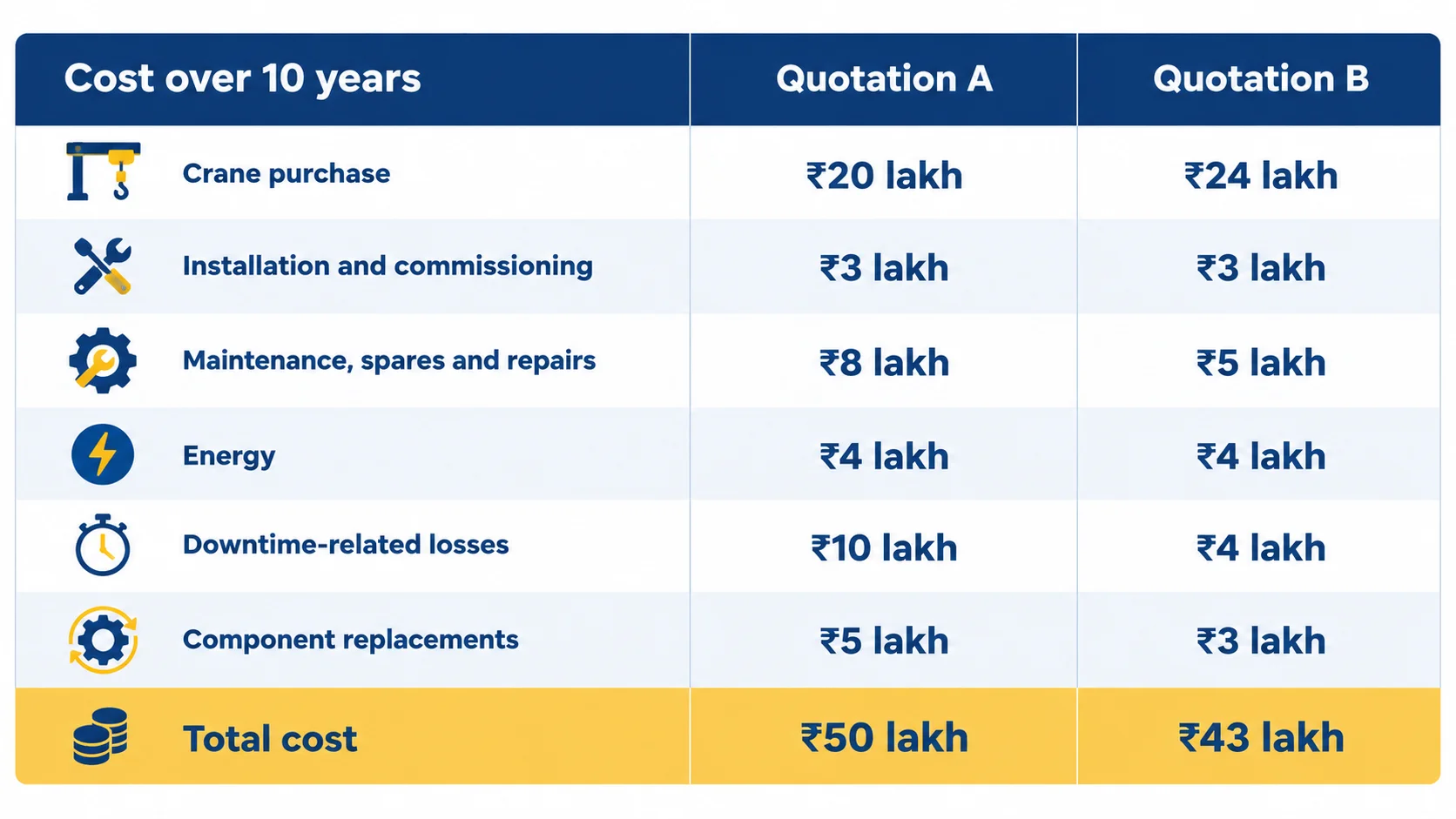
Illustrative figures that assume both cranes meet the same duty requirements.
Quotation A is ₹4 lakh cheaper on day one but ₹7 lakh more expensive over ten years. Ask each supplier for the service life of key components, spare-parts availability and expected maintenance intervals, then test these numbers with your own maintenance team.
Why After-Sales Support Matters
When a crane serves a production-critical area, one breakdown can hold up every process that depends on it. Support quality is therefore part of the price you are paying, not an extra.
Look for a supplier who can handle installation and commissioning, run preventive maintenance, respond to breakdowns, stock critical spares and, over time, upgrade older cranes. Ask for service response times in writing, and ask where their service engineers are based relative to your plant. In South India, a site in an industrial belt with a nearby service team is in a very different position from one that needs a two-day visit.
Macroverse offers installation, preventive maintenance, breakdown support, spares and modernisation for EOT cranes across Chennai, Bangalore, and Hyderabad with a 2-business-day response time. See our Crane Services page for details.
Cranes near the coast or in humid areas corrode faster, so protective coatings, enclosure ratings, and inspection frequency deserve attention at the specification stage. Outdoor and high-temperature sites need their own provisions.
The Final Checklist Before Requesting a Quote
A detailed enquiry shortens the quoting process and reduces surprises later. Have these ready:
Load and lifting: rated capacity, heaviest load including attachments, span, lifting height, hook approach, and the dimensions and type of material.
Building and site: runway beam and column details, headroom and clearances, layout drawings or site photographs, and any access restrictions.
Operation: shifts, operating hours, lifts per hour, typical versus maximum loads, speeds, control preference, and whether the crane is indoors or outdoors.
Project and service: installation deadline, safety systems, maintenance expectations, warranty, and any planned expansion.
If you do not have every detail, send what you have and we can arrange a site assessment. Ask every supplier to quote against the same specification so you can compare equipment, scope, exclusions and service terms side by side. Also confirm which Indian standards the crane is designed to, and that statutory inspection by a competent person is planned.
Weigh Upfront Cost, Performance and Lifecycle Cost
A custom EOT crane in South India is priced by its capacity, span, duty class, controls, safety systems and installation conditions. The upfront quote shows only part of the picture. Operating performance decides how much value the crane returns, and lifecycle cost decides how much it really costs.
Size the crane for your actual duty, estimate payback from your own plant data, and compare quotations on total ownership cost. Confirm installation scope and after-sales support before you commit.
Planning a Custom EOT Crane for Your Plant in South India?
Share your requirements with Macroverse for a project-specific discussion. Send us your capacity, span, lifting height, duty cycle and site details, and we will help you define the right specification.
